Portimão – Lagos 7,6 nm
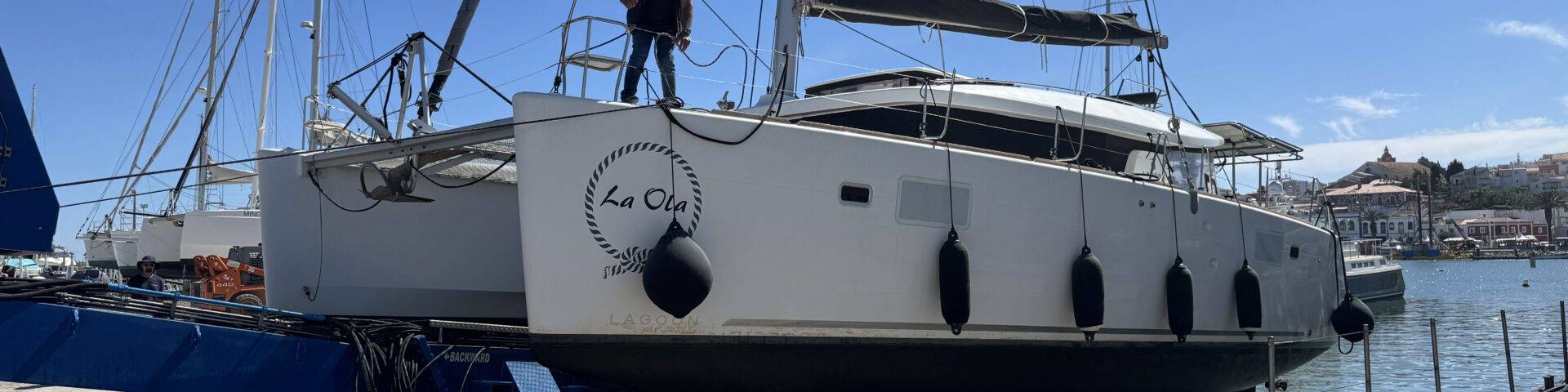
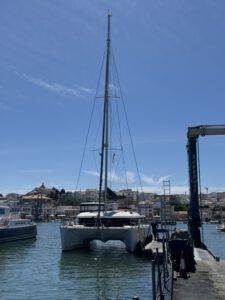
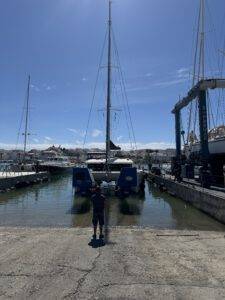
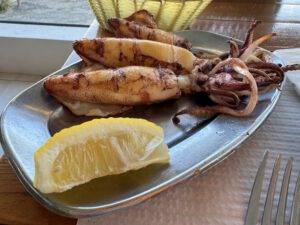
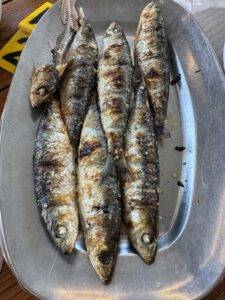
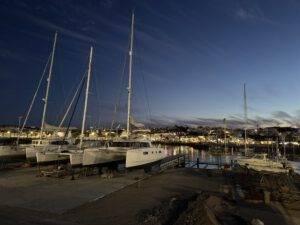
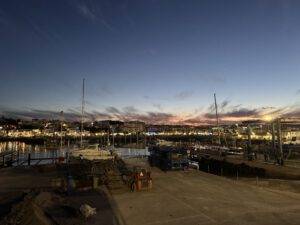
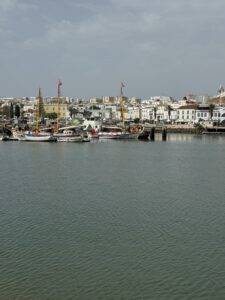
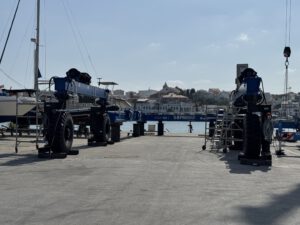
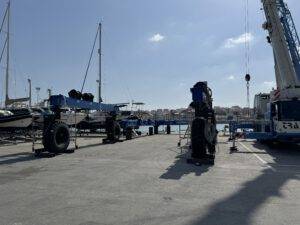
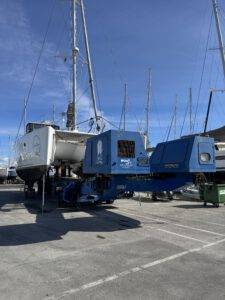
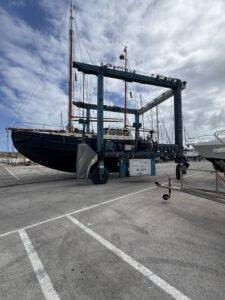
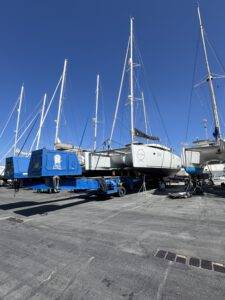
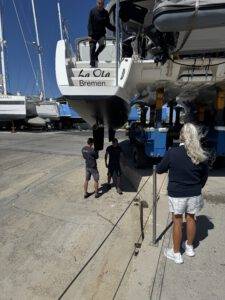
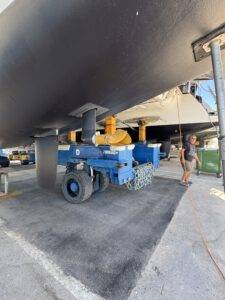
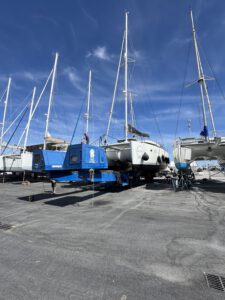
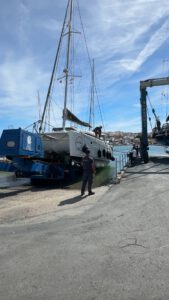
Before we set off for our rescheduled shipyard appointment in Lagos, we first have to deal with the bee problem. With water and the wind picking up, the swarm finally disperses and we’re bee-free again. Over at the Frodo’s—where a swarm of bees has also settled—the wind is also helping to disperse the gathering. Unfortunately, the bees there had chosen the wind generator’s propeller as their resting spot. But riding a carousel wasn’t really their thing after all. Since we aren’t expected in Lagos until 3:00 p.m., we take it easy in the morning and don’t weigh anchor until 1:30 p.m. We chug along quite leisurely on the now familiar route to Lagos. Right on time at 2:55 p.m., we’re moored at the waiting pontoon and first take the bikes off board. That’s easier while the boat is still afloat and not on land. We hand La Ola over to the experienced hands of the shipyard workers, who safely guide her onto the slipway. Then the hydraulic supports are raised, and La Ola can be pulled ashore. Saskia from the Robulla watches the process with us, and we walk together behind the trailer carrying La Ola. Not far, because we get a spot in the catamaran corner right next to the crane and can enjoy the view of Lagos’s old town from there. After we’ve recovered from this exhausting experience, we head to the fish restaurant around the corner with Saskia in the evening. Even though we didn’t really have to do any physical work, it’s always very exciting and mentally exhausting when our floating home is lifted out of its element. Back on board, we enjoy the evening atmosphere in the cockpit for a little while before the mosquitoes drive us inside and into our bunks.
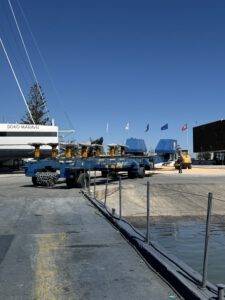
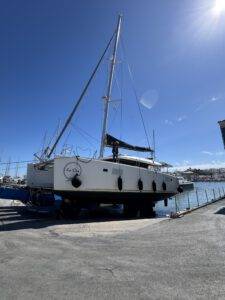
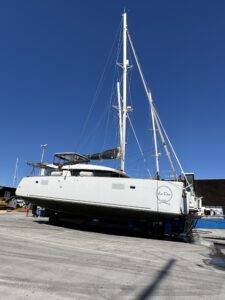
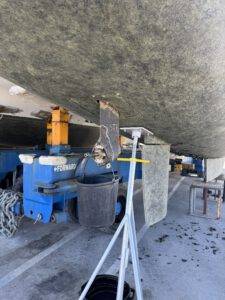
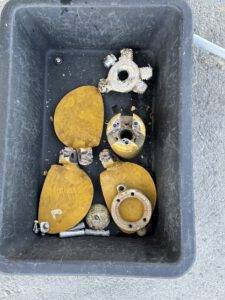
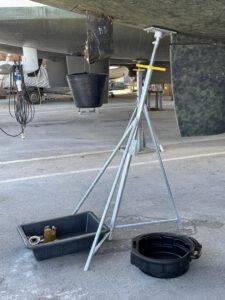
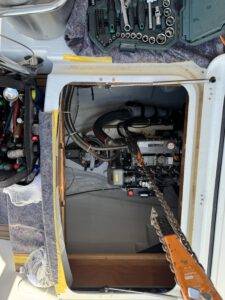
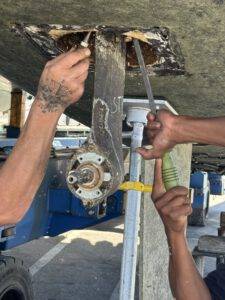
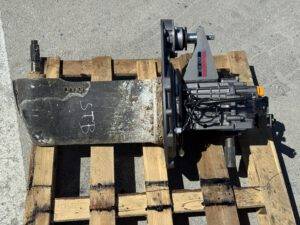
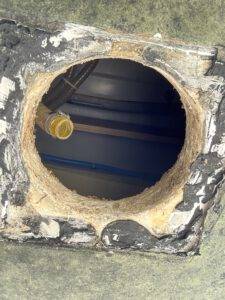
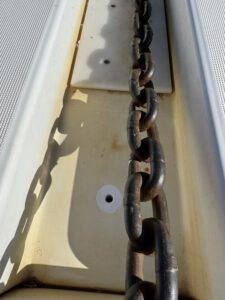
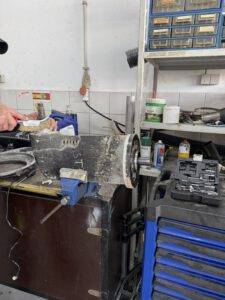
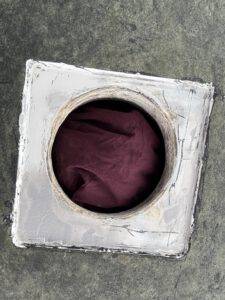
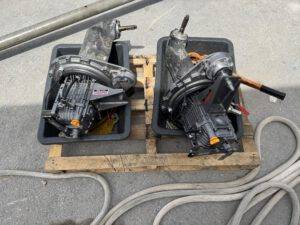
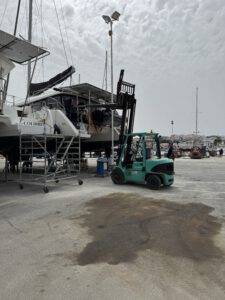
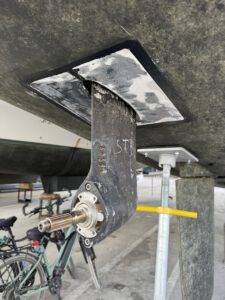
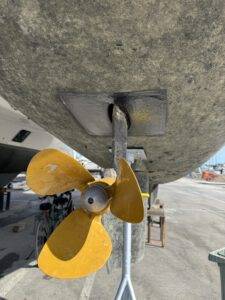
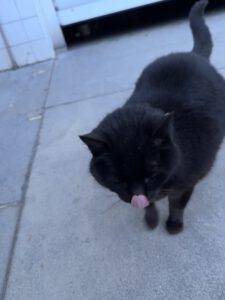
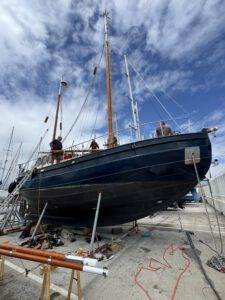
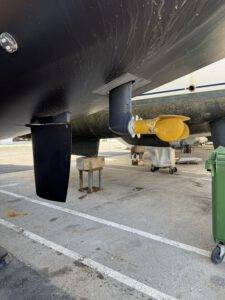
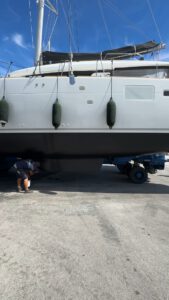
Lucky is keeping us awake again at night, begging for food. Even though his bowl is still full in the saloon, I have to get up and take him to his bowl. Three whole times! Despite this late-night disturbance, we’re up early and head down the ladder to use the restrooms on shore. While Axel settles back into his bunk afterward, I watch from above as the shipyard slowly comes to life. On the side, I write a bit on this blog, sort through photos, and publish the latest post. At 8:30 a.m., the shipyard workers are at the door and get started on replacing our Sail-Drive seals. The seals have to be replaced every seven years, so it’s time. And one of the seals is also leaking. So it definitely needs to be replaced. First, the engine compartments are cleared out, then drop cloths are carefully laid down everywhere to make sure nothing gets dirty. Then the open-heart surgery begins! First, the oil is drained from the Saildrives. To do this, the propellers have to be removed. Then the two engine blocks have to be detached from their mounts. They’re then pushed forward with the help of a crane so that the connection to the Saildrive can be disconnected. Next, the Saildrives are removed from their through-hull fittings. The whole process isn’t exactly easy, since the lower mounting plates are sealed quite tightly. Eventually, though, the Saildrives give way and we end up with two huge holes in the hull. Phew! By now it’s afternoon and our Saildrives are being taken to the workshop. There, they’ll be cleaned and fitted with new gaskets over the next few days. In the meantime, the through-hull fittings need to be cleaned and filled in a few spots. Only then can the serviced Saildrives be reinstalled and everything screwed back together. However, we won’t be able to continue until Monday. While Axel watches the work, I run a few errands. Sabine from the Spätzle has a rental car, so we drive to a few stops. First, we head to the gas station, where I can fill up our gas can for the outboard motor. 20 liters for 40 euros. Then we drive to the hardware store and buy a drill bit for Saskia from the Robulla. Next, we head to Intermarché, where we load a few groceries and drinks into our shopping carts. They even have original Wasa crispbread! A coveted rarity, so of course we pick up two packages. Back on board, Axel proudly shows off what he’s been working on in the meantime. Our anchor chain runs from the anchor winch to the bow through a narrow channel where water has always collected due to a lack of drainage. So when it rained, the chain was always in the water, which of course leads to rust over time and isn’t good. Now Axel has first drilled a drainage hole and second, printed a small cover so that no exposed fiberglass areas can come into contact with the water. He then installed the whole thing flush and without a rim. It looks good and will finally solve the problem of standing water. Now we just need to clean the channel, where the rust has left unsightly marks. But not today! We’re enjoying a glass of wine in the front cockpit at the end of the day and watching the shipyard activity from above. In the evening, we’re heading out for dinner in the old town of Lagos with Sabine and Dirk from the Spätzle, Saskia from the Robulla, and Janis from the Heima for dinner in the old town of Lagos. We’ve reserved an outdoor table at the little restaurant Arribale and are enjoying the lovely evening. Eventually, however, mist and fog roll in from the sea and it gets noticeably chilly. Shivering a bit, we head home and return to our respective boats.
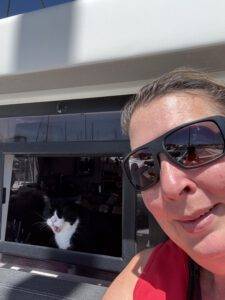
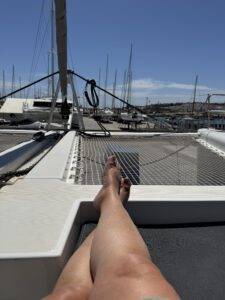
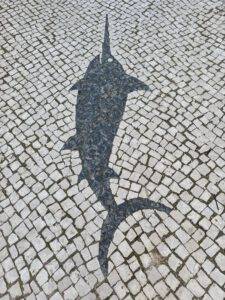
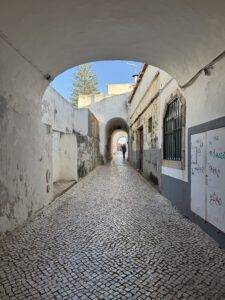
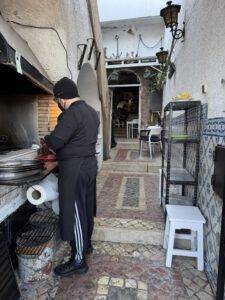
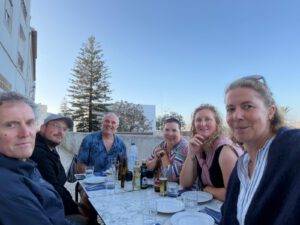
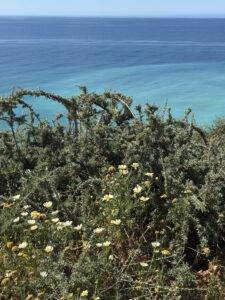
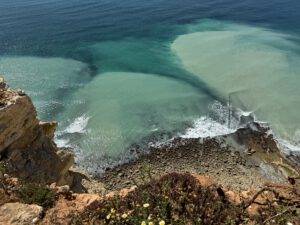
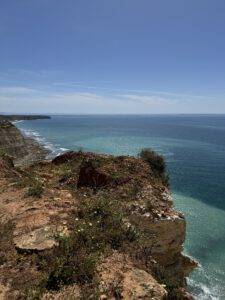
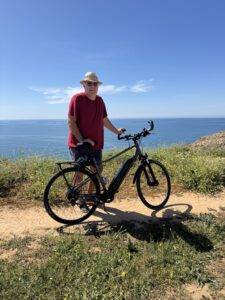
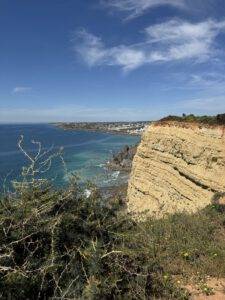
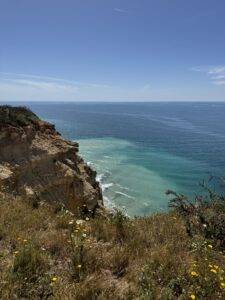
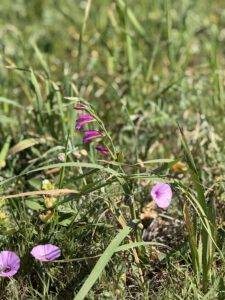
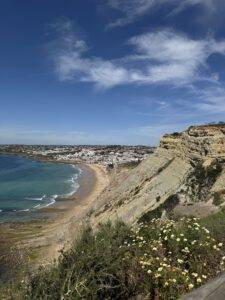
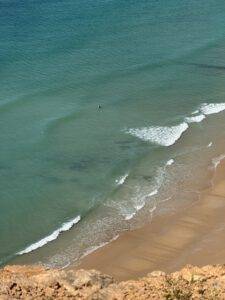
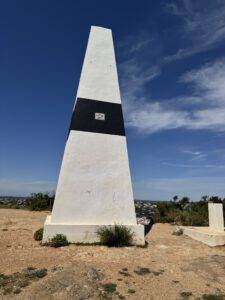
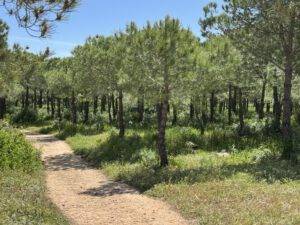
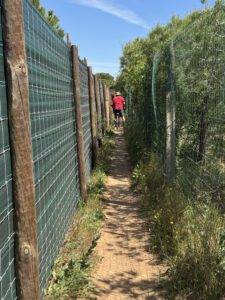
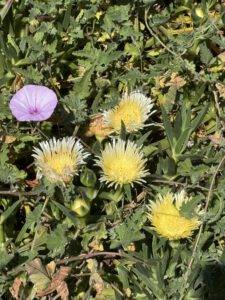
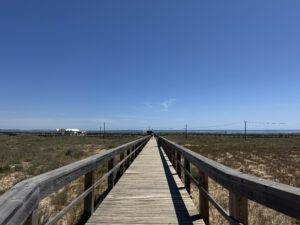
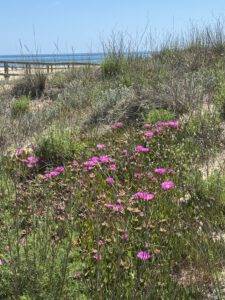
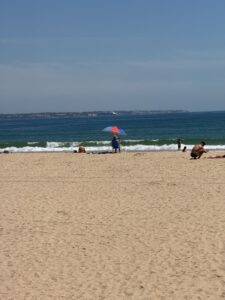
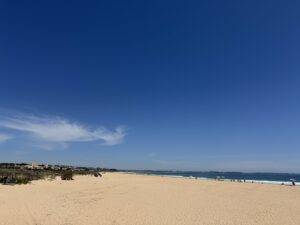
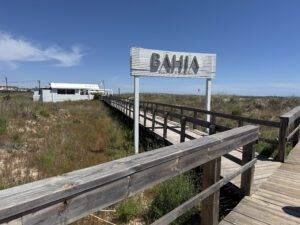
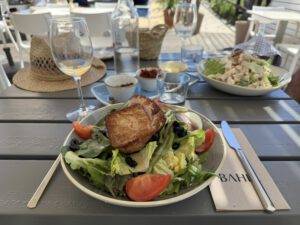
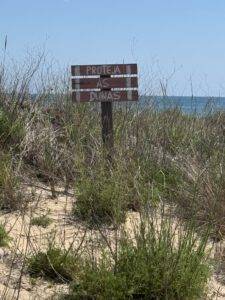
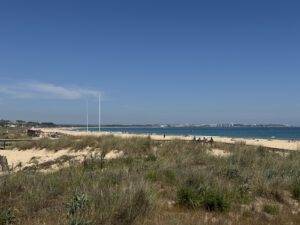
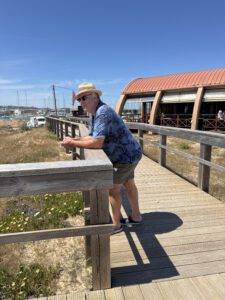
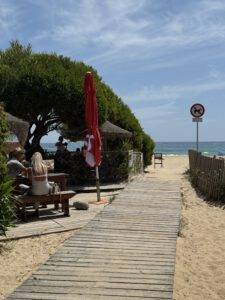
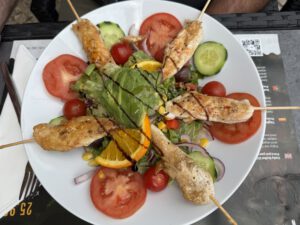
Sunday. A day of rest. Or is it? The weather is too nice to just sit around! So we get the bikes ready and off we go. We ride to the familiar Ponta de Piedade and head west from there. The route to Praia do Canavial follows a nicely paved path along the cliffs. We continue through the well-kept residential areas of Porto de Mós. There we come across the Trilho dos Pescadores, the fishermen’s trail from Lagos to Luz. A gravel path that, according to Google Maps, is supposed to be paved again after a short while. Well, unfortunately that’s not the case. But we bravely keep going and are surprised to find that we’re the only cyclists. No wonder, because the path becomes rocky and steep and is barely passable by bike. So we push our bikes over rough and rocky terrain for long stretches. But the view of this incredibly beautiful coastline is worth the effort! Eventually, we spot our planned destination, Praia da Luz, and are already looking forward to a refreshing beer. But unfortunately, we can’t go any further from the striking Vértice Geodésico da Atalaia. The path down becomes too steep and rocky. And daring jumps on the e-bike in the style of a downhill racer aren’t really our thing. So we turn back and ride a short way through a small pine grove. We continue through a very narrow alley between two property lines until we arrive at the Boa Vista golf course. Now we’re back on track and can continue on paved roads. However, since we’ve already covered half the distance back to Lagos on this route, we skip the visit to Luz and head back to Lagos. After a quick stop at La Ola, we continue on foot to nearby Meia Praia. There, we more or less drop right into the Bahia beach bar and start by refueling with a delicious Caesar salad and Niçoise salad. Afterward, we take a short walk along wooden boardwalks through the dunes before settling back on board for a siesta and a peaceful rest of the day.
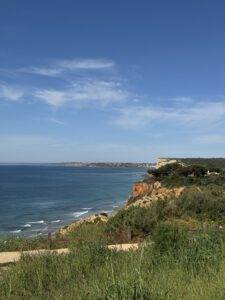
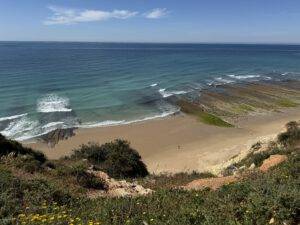
The new week is starting off cloudy and much cooler. Perfect for working. We’re trying to figure out how long our stay ashore will take. The Saildrives are one thing. But Axel would also like to replace our rudder bearings. They already have some play, and it would make sense to replace them before crossing the Atlantic. We ordered and paid for the necessary replacement parts a few weeks ago. However, nothing has arrived here in Portugal yet. If they were to arrive within the next few days, we’d of course prefer to have the replacement done here in Lagos. Otherwise, we’d probably have to get the boat out of the water again in the Canary Islands. Another question on our minds in this context is whether we want to have two more coats of antifouling applied to the hull. If we have to wait a few more days here for the rudder bearings, this would certainly be a job for Lagos as well – provided the shipyard has time for it. If not, we would have to do this in the Canary Islands as well. Questions upon questions that need to be clarified. Our decision on whether and when we might rent a car again also depends on the answers. Getting supplies here locally is no problem at all, whether on foot or by bike. But I still need to take my broken kayak bottom to Decathlon to have it repaired or exchanged. The nearest Decathlon, however, is in Portimão and isn’t exactly within biking distance. To sort out our questions, we head over in the morning to Ricardo, the shipyard employee in charge of our case. He explains that he can also manufacture our oar bearings right here at the shipyard. It will take a few days, but in the end, it’s probably faster than waiting for the rudder bearings from Lagoon. Since, due to the tide, we can either be craned back into the water by Wednesday or not until the next spring tide, a few days’ wait would be bearable for us, provided we don’t have to have work done on the boat in the Canary Islands. The Sopromar staff also have time to work on our hull. So we ask Ricardo for a quote and postpone our decision until tomorrow. Meanwhile, work on La Ola’s saildrives continues unabated. The through-hull fittings have been filled and painted. The saildrives have been cleaned and serviced. Now they’re being reinstalled. While Axel stays on board and works on a small 3D printing project, I grab my bike after lunch at the beach bar Linda and explore the area a bit. This time I head toward the hinterland and eventually end up in a small village called Colinas Verdes. According to my cycling app, it’s only 6.5 km. But somehow the uphill climb takes forever. Now I naively think that the way back should be about the same distance and all downhill. But I’m way off! The app doubles the distance and takes me up and down gravel paths through more or less uninhabited countryside. Beautiful, but super exhausting. And unfortunately, I also forgot to bring a bottle of water. After two hours and just under 25 km, I finally made it back to Lagos and was greeted by Axel in the cockpit with a cold beer. Our Saildrives are now installed, and all that’s left is to reattach the propellers. Axel has also finished his printing project, and we’ll be able to launch our dinghy even more easily in the future. When I walk into the salon, there’s a lot of excitement. Lucky is hopping back and forth and jumping from left to right. A little sparrow has wandered into the salon and can’t find its way back out. I try to catch the little bird while simultaneously stopping Lucky from doing the same. With Axel’s help, a blanket, and a towel, I finally manage to catch the little bird and release it back into the wild unharmed. Much to the disappointment of Lucky the cat, who spends hours searching for the tasty morsel. A short while later, a black cloud of smoke catches our attention. There’s a fire at Meia Praia with heavy smoke. It looks like oil and/or tires are burning. Maybe a car caught fire? Hopefully not a boat in the Alvor lagoon! We then spend the evening quite comfortably on board without any further excitement.
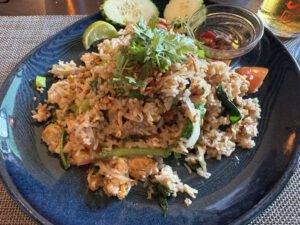
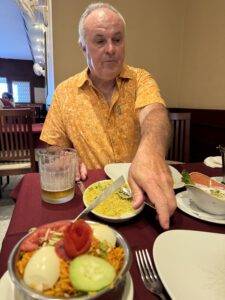
The next morning is even cloudier, and the weather forecast threatens rain. Since Saharan sand is also expected to blow our way again, we’ve brought all the cushions inside and closed La Ola as tightly as possible to keep the dirt to a minimum. But we’ve already scheduled a final boat wash at the end of our stay at the shipyard, so it doesn’t bother us too much for now. Our propellers are being reinstalled and the sacrificial anodes replaced. Although the old anodes still look good, we’re taking the opportunity to swap them out and hopefully won’t have to worry about them for another two years. While work is being done on the boat, Axel and I bike over to Aldi and pick up some groceries. New on the menu: licorice! Back on board, we try once again to figure out what’s going on with our rudder bearing. Unfortunately, we can’t find out a thing. Lagoon isn’t responding, and Sopromar hasn’t made an offer either. Instead, we go out for a delicious Thai dinner with Dirk in the evening and then continue chatting over a glass of wine back on board.
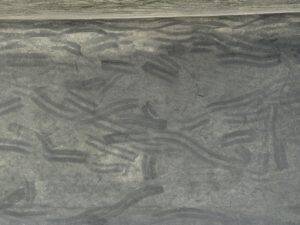
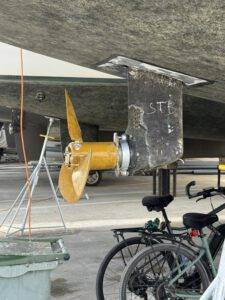
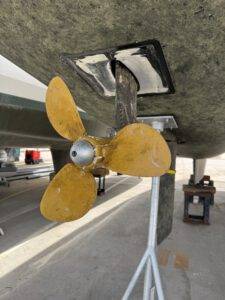
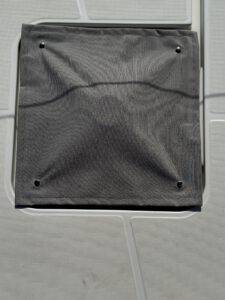
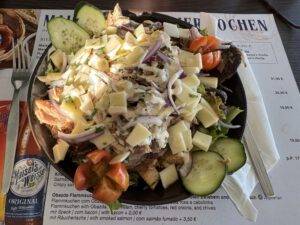
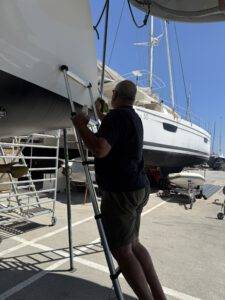
It’s Wednesday, and we’re still high and dry. Hmm. We call Lagoon again. No news. They promise to look into it and get back to us. Then we go to Ricardo and press him for answers. He doesn’t have a quote for the rudder bearing yet. And for two coats of antifouling paint, he wants about 5,000 euros plus VAT. Last year we paid half that! But maybe one coat will be enough? After all, the antifouling still looks good. Aside from the fact that the fish have left artistic patterns on the hull and keels. Back on board, we finally install the sun covers I sewed for our deck hatches. So we’ve finally checked that item off our never-ending to-do list. In the afternoon, we receive the rather frustrating news from Ricardo that, unfortunately, they can’t just whip up our rudder bearing for us after all. Damn! And his supplier, whom he asked for a ready-made replacement part, isn’t getting back to him either. Double damn! We call Lagoon again, but all we get is the same response: they haven’t received any information about a delivery date. Triple bummer! But somehow we knew that a stay on land like this wouldn’t just go smoothly, quickly, and on schedule. Looking on the bright side, the extended stay in Lagos doesn’t really bother us. We’re safely ashore and don’t have to worry about the weather or finding a safe anchorage. According to long-range weather forecasts, it will be another 6 to 10 weeks before the Portuguese north wind sets in, allowing us to sail comfortably to Madeira. Accordingly, we had planned our crossing for June or July. So we have plenty of time to wait for the spare parts from Lagoon and to have the hull treated. The only thing that bothers us a little is that it’s somewhat uncomfortable on board. We always have to climb a steep ladder to get on board, use the toilet and shower on land, cooking and washing dishes are only possible to a very limited extent, and there’s a lot of noise from the shipyard during the day. But there are worse things, so we remain positively optimistic and hope that one coat of antifouling will be enough (we’ll have to see once the boat has been pressure-washed) and that our rudder bearings will be delivered by Lagoon as early as next week after all. Until then, we’ll just enjoy Lagos a little longer. After we’ve all processed the frustrating news, we head into town. At the Bavarian beer garden “Munich,” there are tasty treats and fine wheat beer. While Axel enjoys an Alsatian tarte flambée, I try a Bavarian Caesar salad with pulled grilled pork knuckle and pretzel croutons. Delicious!
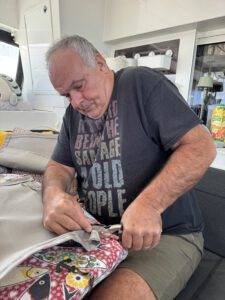
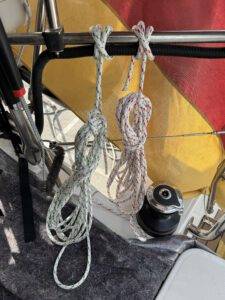
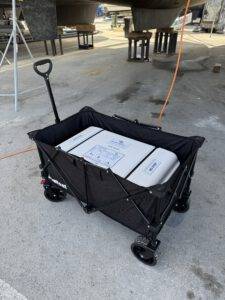
We’ve finally received word on when our rudder bearings will be delivered. They’ll arrive at Lagoon in France on April 27 and will then be shipped to us in Portugal. With a bit of luck and via express delivery, they should hopefully be here by the end of April, so we can get back in the water in early May. Let’s just keep our fingers crossed! After breakfast, we’re heading to Portimão today. Axel rented a car because we have a few things to take care of. First, we drive to the shipyard in Parchal, where our freshly serviced life raft is waiting for us at Slickhull. It was tested for functionality and had some parts replaced. Not parts for the life raft itself, but additional contents, such as water and distress signaling devices. After loading the life raft into the car, we head to Decathlon, where we drop off the broken kayak bottom. It will now be checked under warranty and then repaired or replaced. Then we buy a few groceries and stow them back on board. Thanks to our new folding handcart, we can easily move the life raft from the car to the boat. That’s a good thing, because the raft would be way too heavy to carry, and the distance from the parking lot is way too long. Axel then cleans the life raft mount before we can proceed any further. Axel and I can’t lift the liferaft into the mount without a stand or some serious help. So we finish another project first. We have new lines for our davits, into which the local sailmaker has now spliced an eye on each one. The old lines still look fine, but they always got badly twisted when we hauled up the dinghy. We’re hoping the new lines will be better. Plus, the new lines are now different colors—red and green. That way, we can’t mix them up anymore: we’ll know which line needs to be pulled and which cleat can be opened safely. We’re spending a quiet evening on board today, watching a little TV.
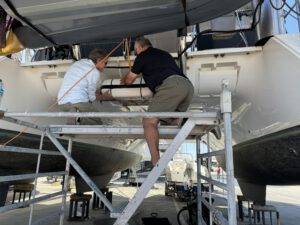
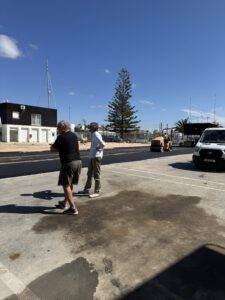
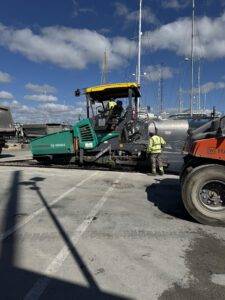
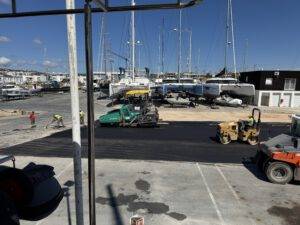
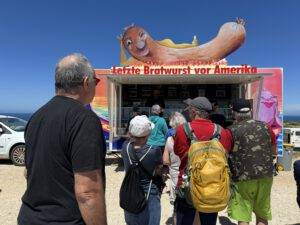
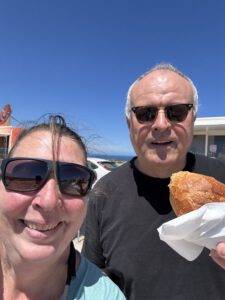
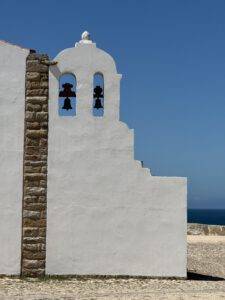
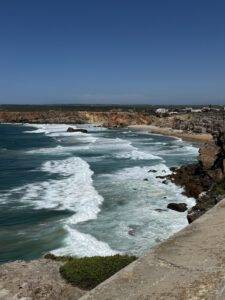
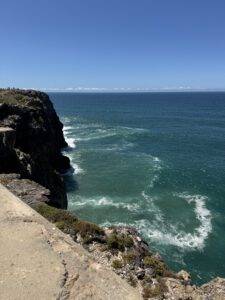
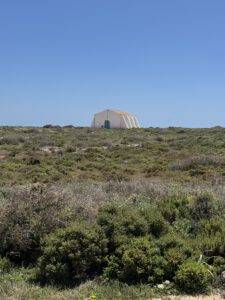
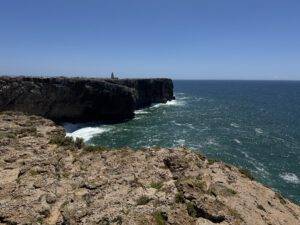
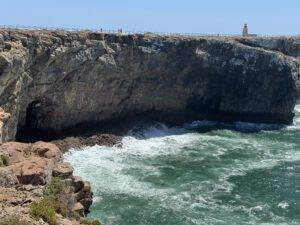
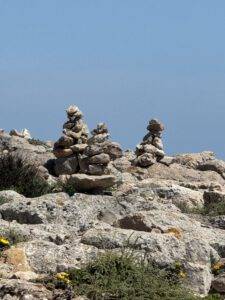
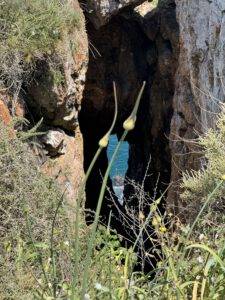
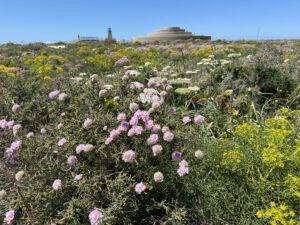
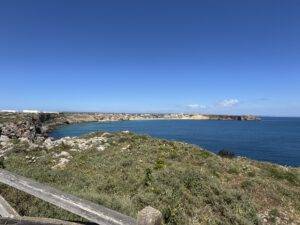
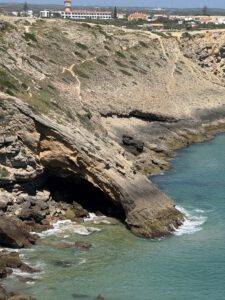
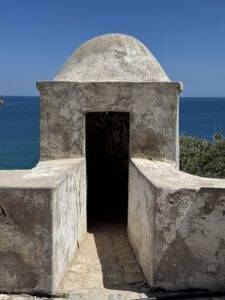
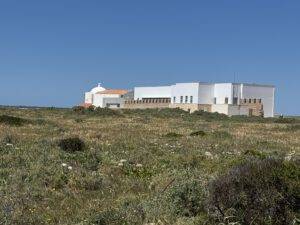
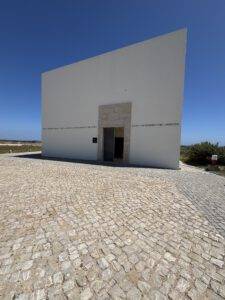
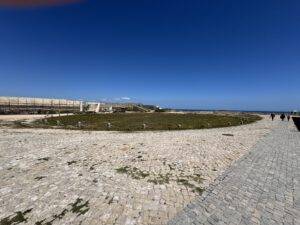
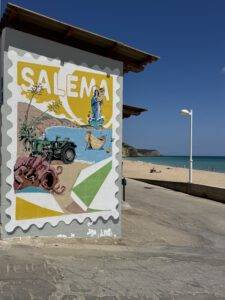
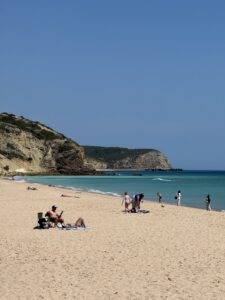
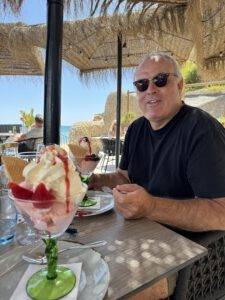
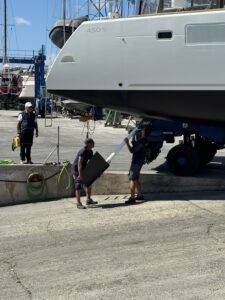
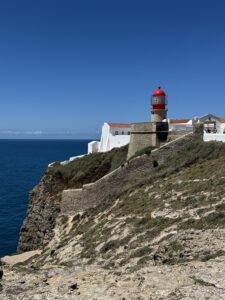
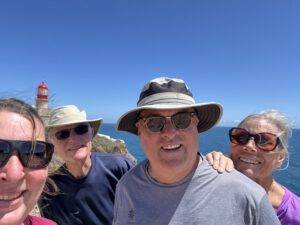
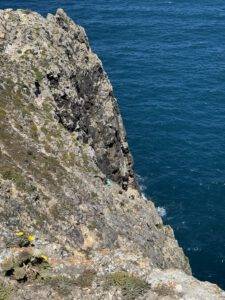
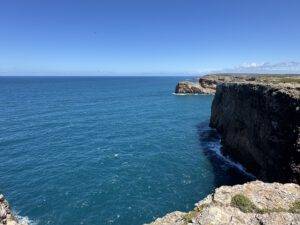
We’re woken up in the morning by construction noise. Behind our stern, a large area has been leveled and prepared over the last few days. Now they’re apparently going to pave it. While the construction workers get everything ready, we take care of our life raft. With Dirk’s help and the scaffolding from the neighboring boat, we’re able to secure the heavy box back in its place. After that, we quickly make a beeline for the open sea. The noise and the stench of tar and asphalt are simply unbearable. We head west until we can go no further. We’ve been to Cabo São Vicente a few times before, but there’s still one tourist highlight left on our agenda: the famous “last bratwurst before America,” as seen on radio and TV! On our previous visits, the food stand was always closed, but this time we’re in luck. We don’t have to wait long and get a top-notch Thuringian bratwurst in a bun with Bautzen mustard. Delicious! Well-fortified, we head back a short way toward Sagres. Another sightseeing highlight we haven’t managed to see yet: a visit to the Fortaleza de Sagres. We stride through the venerable gates and wander through the sprawling grounds. The view of the sea from the circular path is impressive. Even though the Atlantic is rather calm today, the waves crash against the beaches and rocks. In some places, the sea has hollowed out the rocky coast over the millennia, creating cracks that now allow a view from above through tons of rock down to the sea. Unfortunately, one highlight we really wanted to see is no longer there. There used to be a huge compass rose at the fortress. Today, it is unfortunately completely overgrown, and only the outer circle is visible. What a shame. To wrap things up, we take a look inside the modern museum, which offers information about Henry the Conqueror and the discovery of the world. However, there is alarmingly little inside the massive building, so we’re out again in no time and turn our attention to new destinations. We head back about 20 km toward Lagos. At Santo António Golf & Spa, we turn off and drive into the small village of Salema. Salema is a small, still quite unspoiled fishing village and is considered an insider’s tip in the Algarve. No sooner have we stepped out of the car than we can immediately confirm this assessment. The beach and the turquoise water are simply breathtakingly beautiful! No mass tourism, just nice little cafés and restaurants. I also spot our dream property right away. But it will likely remain just a dream, because given the location and the view, we’re definitely talking about a sum in the tens of millions here. But luckily, dreaming isn’t forbidden. We stop at one of the restaurants and enjoy a delicious ice cream sundae. With a view of this incredibly blue water, accompanied by nice lounge music, in the sunshine and pleasant temperatures. We could sit here forever! Eventually, reality catches up with us again and we drive back to the shipyard in Lagos. There’s still noise and work going on. But after half an hour, the fun is over for now and it’s time to call it a day. We enjoy a little more sun in the front cockpit, eat a ready-made salad from the supermarket, and then treat ourselves to Bohemian Rhapsody. One of our absolute favorite movies.
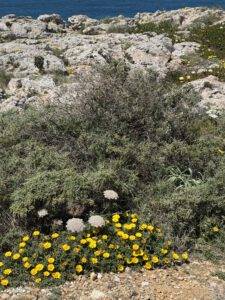
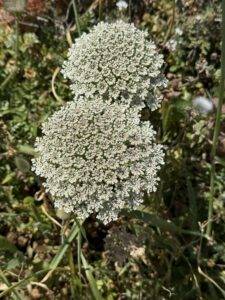
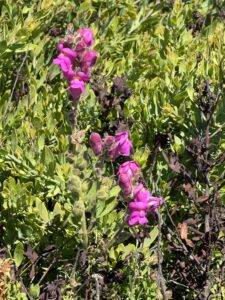
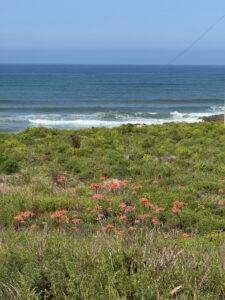
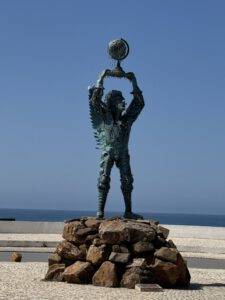
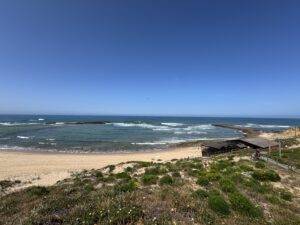
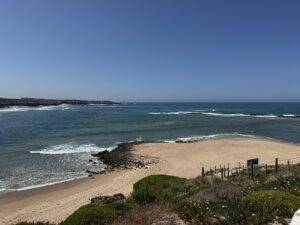
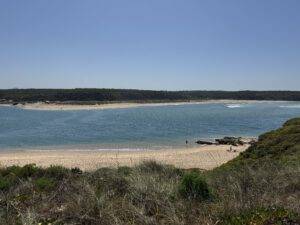
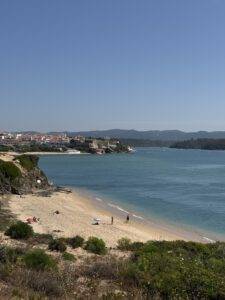
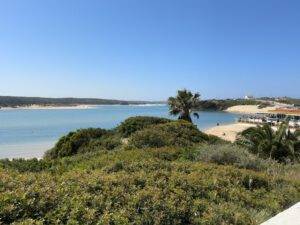
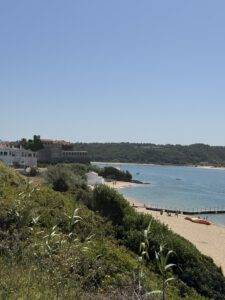
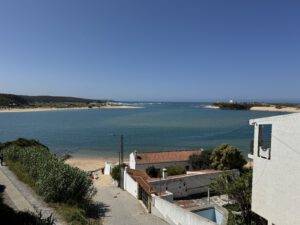
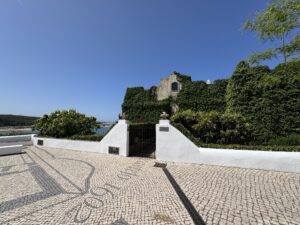
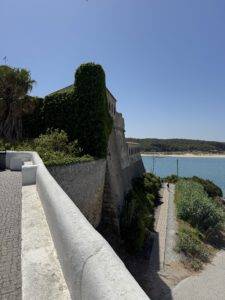
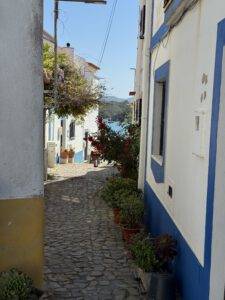
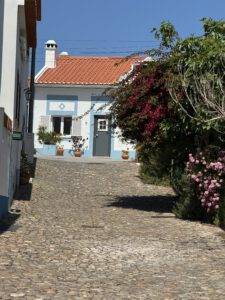
Finally, the weekend! And a holiday! Yes, here in Portugal, April 25 is a holiday known as Dia da Liberdade – Freedom Day. On this day, Portugal commemorates the uprising of the Portuguese military, which carried out a coup on April 25, 1974, thereby ending the dictatorial regime of the Estado Novo under the leadership of António de Oliveira Salazar and marking the beginning of democracy. The military coup was supported by large segments of the population and thus proceeded largely without bloodshed. The event also became known as the Carnation Revolution, as supporters placed red carnations in the barrels of the rebels’ rifles. We’re using the day for another outing. There’s a place we’ve been wanting to visit, and for once, it’s not in the Algarve but in the Alentejo region. Years ago, we saw a report about Vila Nova de Milfontes and now want to see if it’s really as beautiful as they say. We’ve also read that, in calm weather, you can sail into the river and anchor safely in front of the village. We want to check that out, too. We drive 1 1/2 hours north and once again enjoy the stunning scenery. The air smells of eucalyptus, and flowers of every color bloom along the roadside. A wonderful variety of wildflowers, the kind you unfortunately rarely find in Germany anymore. Only as we approach our destination does the landscape become more cultivated. Vast agricultural fields with irrigation systems already in operation. Huge forested areas with cleared eucalyptus groves. Eucalyptus is not native to Portugal and is cultivated for timber. Unfortunately, it not only displaces native species but also spreads quite uncontrollably. The tall trunks also snap easily in winter storms and fall onto power lines. This has frequently caused—and continues to cause—power outages. Eventually, we reach the Rio Mira and cross it via a small bridge. The water looks an incredible shade of blue, and from the bridge we catch our first glimpse of Vila Nova de Milfontes. We drive into the village and follow a long, winding road into the old town and on to the river mouth. From here, you have a good view of the entrance, which, under current conditions, would likely be quite difficult to navigate by boat. To the left and right of the entrance, waves crash against the beach and rocks, making it impossible to discern the correct path in. Unfortunately, the entrance is not marked with buoys, so good visibility is essential to avoid running aground on a sandbar. Even after passing through the entrance, there is a large sandbar in the river that must be navigated around based on visibility. It’s not until just before the bridge that you see yachts at anchor and tied to mooring buoys. The conditions for entering here would therefore have to be absolutely ideal. We walk into the old town and stroll a bit through the alleys. It’s very nice, colorful, and you often get a view of the beautiful river water. So the report wasn’t exaggerating. With a little more time, you could kayak up the Rio Mira or simply enjoy one of the many river beaches. We eventually head back toward Lagos and stop by Arrifana. At our favorite restaurant, O Paula, we enjoy a delicious lunch in the sun. Octopus for me and tuna for Axel. As always, very, very tasty. At the next table sits our favorite stainless steel specialist, Sergio from Vilamoura. He went on a motorcycle tour with his friends. Not a bad idea given the weather and the beautiful motorcycle route! Back on board, we enjoy the sun a bit more in the front cockpit as usual and spend a quiet evening on board.
Sunday gets off to a quiet start. Breakfast. With eggs! Showers on shore. Then we settle in to do some work on the boat. Axel designs a few washers for our pulleys in the davits and starts the 3D printing job. Our davit lines not only tend to twist, but also like to slip off the pulleys and get stuck there. Now we’re adding printed washers to prevent this. Then we tidy up our cockpit. There are boxes piled up there that normally sit in the engine compartments. Since work on the engines and sail drives is complete, they can now be put back in their places. Before that, we install warning sensors in the engine compartments to alert us to water ingress and overheating in the future. What sounds so simple in a sentence takes the whole morning on board. Because, of course, the task involves our favorite sport: boat yoga. Imagine it like this: As if in slow motion, I place one foot on the engine block. I lower my center of gravity and place the other foot next to the engine mount further down. A slight 90-degree turn, and then both feet a bit further down next to the oil pan. Feet one behind the other, transitioning into a kneeling position while deftly navigating around cables, hoses, and vent pipes. Finally, my shoulders and head follow, then my hands go even further down and around the engine block in another 90-degree angle. The thought of a chiropractor or physical therapist briefly crosses my mind, but to enjoy their treatment, I’d first have to get out of the engine compartment. And the work hasn’t even started yet. Head and shoulders up again, gather cleaning supplies and rags, down again, and clean everything thoroughly. Head and shoulders up again to take the water sensor mount from Axel, which he’s now coated with Sikaflex. Head down again and stick the mount onto the cleaned spot. Up again! Now I take the sensor from Axel and go back into the upside-down position to place the sensor in the bracket. Slowly sit up again and get all my bones back into the right position before the next sensor has to be attached. That one is screwed on and requires kneeling, leaning my head back, and screwing with both hands into a wooden board. Finally, with more contortions and using our barbecue tongs and various rags, I remove the water from the bilge that leaked in from some hoses while replacing the Saildrive seals. Well, and then the whole thing all over again, because we have two engines! But we manage that too, without a herniated disc. Afterward, we stow all the boxes back in place and now have significantly more space in the cockpit again. In between, I scramble down our ladder and take a load of laundry to the shipyard washing machine. Forty minutes later, the laundry is done, and I load it into the shipyard dryer. An hour later, that’s done too, and the fresh laundry can climb back up the ladder onto the boat. Well, and somehow the day is already over. We walk to the beach and check out the third beach bar. At Restaurante São Roque, we enjoy a Caesar salad and cheeseburgers. Both are very tasty and good. In the evening, we watch the episode of Tatort from Vienna, and before we know it, we’re back in our bunks.
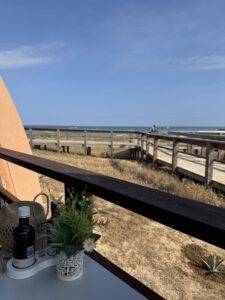
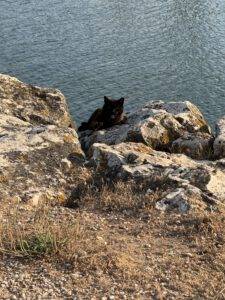
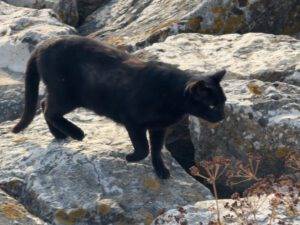
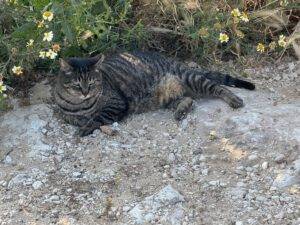

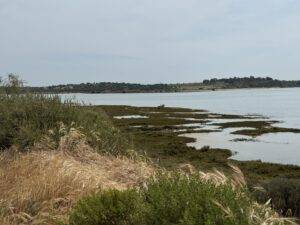
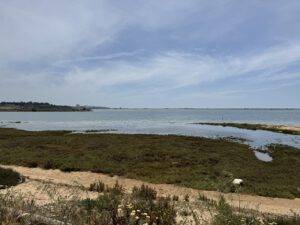
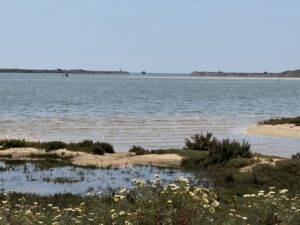
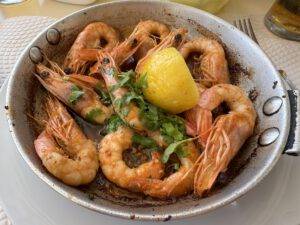
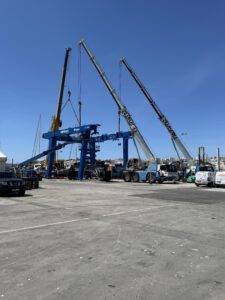
It’s finally Monday again, and the weekend’s lazing around is over. Well, at least for the construction workers. They start up the concrete cutter behind our stern at 9 a.m., creating a rather unpleasant atmosphere. They’re also paving again. And on top of that, the first parts for the new 60-ton travel lift are being delivered. It’s actually kind of exciting to see something like that broken down into individual parts. For our own work, however, it’s too chaotic for us today. We’d rather take the bikes and head toward Alvor. We reach the lagoon quickly and continue through the Vale da Lama. Next to one of the oyster farms, we spot the source of the smoke from last week. Apparently, a shed and its contents went up in flames. We also spot a pair of bee-eaters, though unfortunately we can’t really capture them in a photo. Too bad, because these colorful birds are really worth seeing. Finally, we reach the N125 highway and turn back, as we’d rather not ride along the busy main road. Back at Meia Praia, we stop at the Quim beach bar and enjoy a delicious shrimp dish for lunch. The service, however, is surprisingly unfriendly—that’s not how we know the Algarve at all. But the view of the surf and the fairly empty beach, as well as the live music from the neighboring restaurant, make up for it. Finally, we head back to the shipyard, where unfortunately there’s still noise and a stench. Not pleasant, but we’ll just have to put up with it if we don’t want to flee again right away. And there really are worse things. Unfortunately, the work won’t be fully completed today either, so it’ll probably be loud and smelly again tomorrow. Meanwhile, more parts have been delivered for the travel lift, and we’re curious to see how this giant puzzle will eventually turn into a crane. Who knows, maybe La Ola can already go into the water with the new lift? But maybe not necessarily as the first test subject!
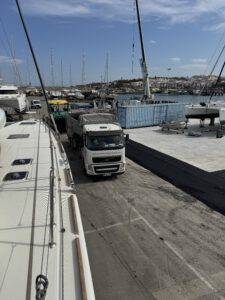
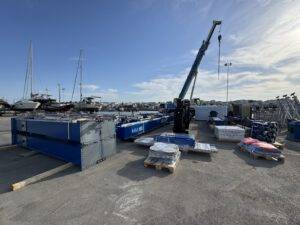
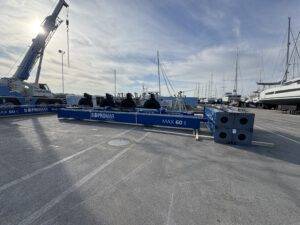
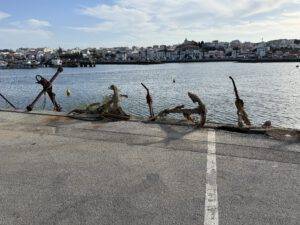
Since we didn’t really get much done on board yesterday, we’re finally making a couple of small steps forward today. We’re clearing out the engine rooms again, and a mechanic is coming to work on our rudder mountings. Once those are loosened, the port rudder is carefully lowered out from below. However, the rudder shaft is too long, so the rudder can’t be removed completely. We’re curious to see how the shipyard workers will solve the problem, because the crocodile lift can’t actually lift us any higher. And we’re about a meter short. Unfortunately, the lift is fully booked today anyway, so the rudder removal project is postponed for now. In the meantime, Axel installs the printed rollers in the davits, and we can cross off another very small item from the to-do list. We spend the rest of the day lazing around, watching as the travel lift delivered yesterday is assembled. It’s coming together, though the new lift probably wouldn’t be suitable for La Ola. Weight-wise, it’s not a problem, but it doesn’t seem wide enough to handle our nearly 8-meter beam. But in two weeks, a second new lift is scheduled to arrive, which will then handle over 100 tons and a width of 12 meters. We hope, however, that we’ll already be back in the water by then. Tonight, we head out to the Indian restaurant Delhi Darbar for dinner. I order chicken tikka biryani, and Axel enjoys chicken balti. We have garlic naan and raita on the side. Everything is super delicious and good. Back on board, Janis from the Helma stops by and borrows our endoscope to inspect his masts. After finishing his work, he joins us for a glass of wine in the cockpit, and we chat once again about life on a sailboat and its challenges.
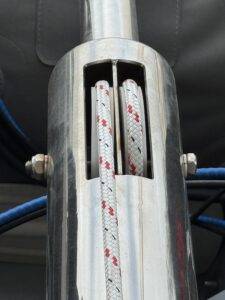
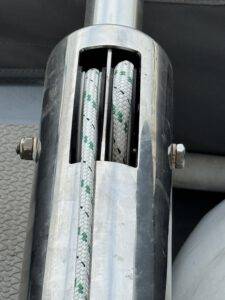
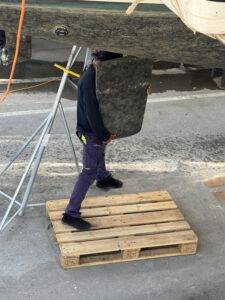
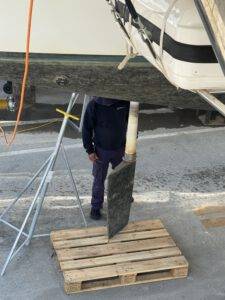
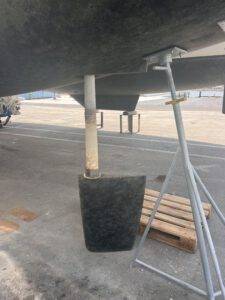
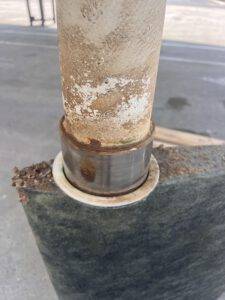
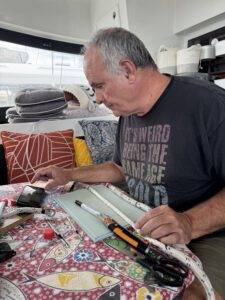
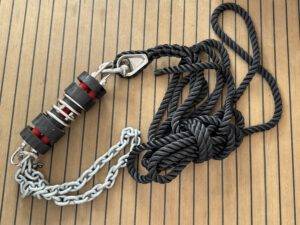
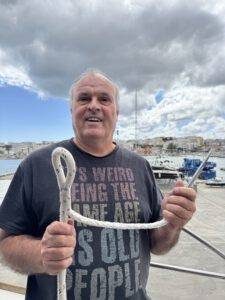
The next day, we’ll start our next project on the upper deck. We’ll install a preventer. The line is designed to prevent the main boom from swinging uncontrollably to the other side during an unintended jibe on downwind courses, thereby causing damage. Damage to the equipment, but also to people—that is, to us. We attach two short lines to the mainsheet fitting, which can be secured to a cleat on the boom when not in use. We can now attach two very long lines to these, running to port and starboard, which hold the boom outward when it is extended. To do this, the lines are pulled from the end of the boom through the cleat at the bow and secured to the aft cleat. We still need a few parts for this and quickly buy them at the Sopromar shop on the shipyard grounds. We’re also missing an eye on one of the long lines. We could, of course, have the eye made by the sailmaker. But we decide to finally learn how to splice ourselves and buy the necessary tools. We can already splice standard, twisted rope. Modern core-sheath braided rope, however, we haven’t yet. I did take part in a splicing workshop about 30 years ago and learned how to splice there. But I haven’t used that knowledge since, and surprisingly, I’ve completely forgotten how to do it. Luckily, there’s YouTube and plenty of videos, which we’re now watching diligently. Numerous sweat beads, a lot of tugging, and video-watching later, Axel actually managed to splice an eye. But it’s unlikely to become his new main job. Another project is our new heavy-duty shock absorbers. A few months ago, we bought steel springs designed to dampen the boat’s movement when it’s rocked by swells and waves in the harbor. We’re now attaching thick mooring lines to these springs on the boat’s side and a thick steel chain on the dock side. The chains can then be looped around a cleat or through a mooring ring in a bay. We’re using chains so we can also moor to stone piers without running the risk of the chains chafing against the concrete. Unfortunately, the shipyard isn’t working on La Ola. We had actually expected them to lift La Ola today and continue removing the rudders. But nothing is happening. They aren’t working on the antifouling paint job either. And we haven’t heard anything from Lagoon about whether our rudder bearings are on their way to us. Unfortunately, they aren’t responding to our inquiries. Kind of frustrating! But hey, four weeks with engine trouble during the rainy season with 100% humidity back then with Hello World in Panama were worse! We grab our bikes again and cycle out to do some shopping. A little later, fried eggs are sizzling in the pan and we’re sitting in the cockpit, well fed. Then, however, we get a call from Axel’s parents that leaves us feeling slightly desperate. A package has arrived for them. In Bremen. From France. From Lagoon. Our rudder bearings!!! To be honest, we have absolutely no idea how something like this could happen. In our order, in our emails, and in our phone calls, we specified the shipyard in Lagos as the delivery address. So why is the package now in Bremen?! We swallow our frustration and arrange for it to be forwarded to Portugal. All that’s left is to wait and see when the package will finally arrive. After all, Friday is a holiday and then the weekend. It’s going to be pretty tight, given the time window next week to get us back in the water for the next spring tide.
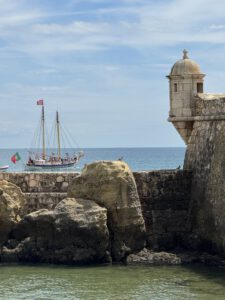
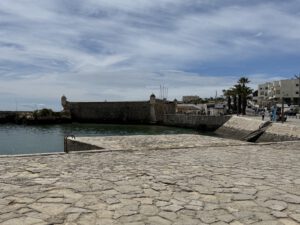
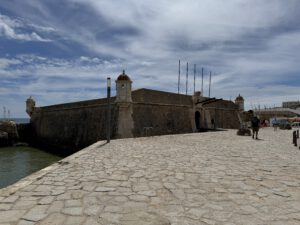
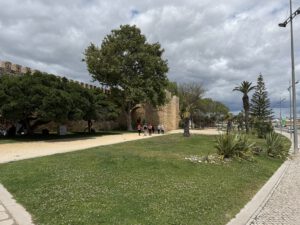
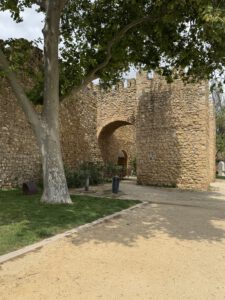
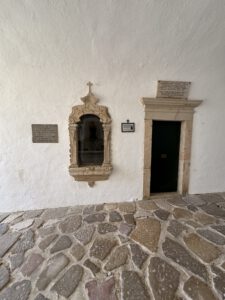
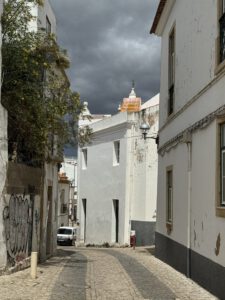
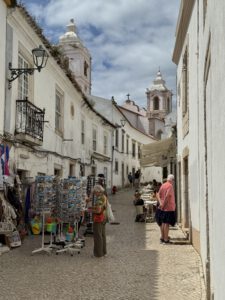
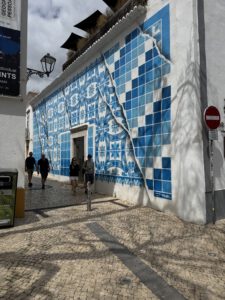
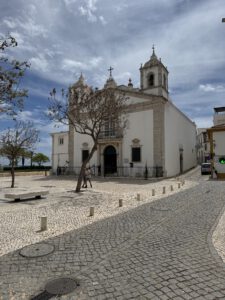
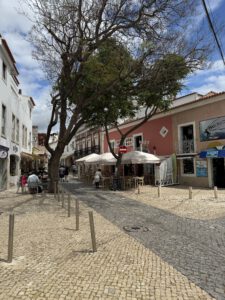
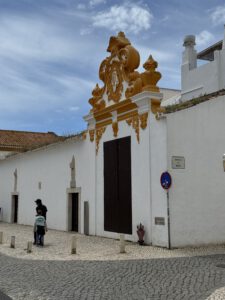
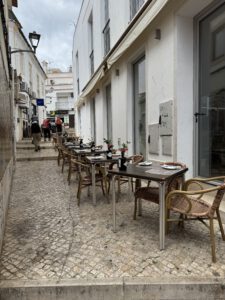
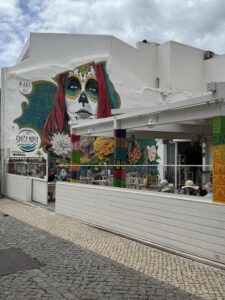
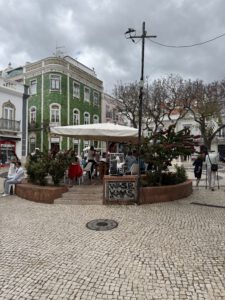
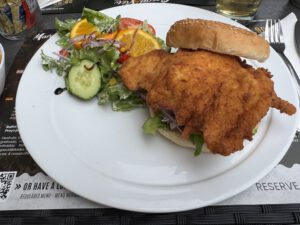
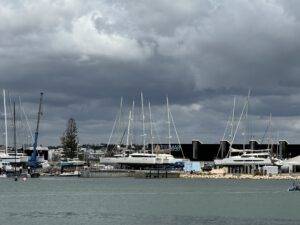
Now that we’ve recovered from yesterday’s shock, our replacement parts are finally on their way to us, thanks to Axel’s father. The shipyard has been notified and is planning the next steps. First, La Ola needs to be lifted out of the water so the two rudders can be removed. This is expected to happen on Saturday. While she’s out, they’ll check whether the rudder bearing shaft has been worn down and needs to be re-laminated. Then La Ola can get a new coat of antifouling. As soon as the new rudder bearings finally arrive in Portugal, La Ola will be lifted again and the rudders reinstalled. Unfortunately, when we’ll actually be able to get back in the water depends on many factors. We’re still hopeful that everything will go smoothly from here on out. Especially since we have visitors coming in May. Our American friends Marcie and David, whom we met in Panama in 2008, are currently traveling the Way of St. James in Portugal and Spain and plan to stop by to see us afterward. Of course, we’d love to go sailing with them a bit along the Algarve rather than staying on land. We’ll see. Since we have almost no projects left to complete on board ourselves, we can devote ourselves to other things in the meantime. We watch as the new travel lift continues to be assembled. When this gets too boring for us, we go for a walking tour of exploration. We walk to the other side of the river and to the small fortress of Ponta da Bandeira. It’s picturesquely situated at the harbor entrance, but unfortunately it’s closed. So we cross the main street and pass through the ancient city wall via the Porta de São Gonçalo. Behind the city wall lies the old town of Lagos. Residential neighborhoods border bustling pedestrian zones. Cafés line up next to restaurants and the numerous souvenir shops. We turn left and right around the corner and discover the surprisingly large downtown area of Lagos. At every other corner, an enticing aroma of garlic, grilled sardines, or other delicacies wafts through the air. We’re getting hungry and really just have to decide where to settle down for lunch. In the end, we end up at Restaurant Maré on the roof of the market hall. We were here last year with my mother Bärbel and have fond memories of it. Not just because of the beautiful view, but also because of the food. And so it is this time as well. The chicken-avocado burger and Indonesian salad taste great, and from our table we can see the La Ola on the other side of the river. Well-fed, we eventually head back on board. We spend the afternoon visiting our friends on the other boats. At Janis’s boat, Heima, work continues on his wooden masts; Saskia from the Robulla is taking care of her cockpit floor. At Dirk’s boat, the Spätzle, we inspect the rudder and rudder bearings for cracks. Of course, we also do another construction check on the new crane. You can actually pass the time quite nicely at the shipyard!
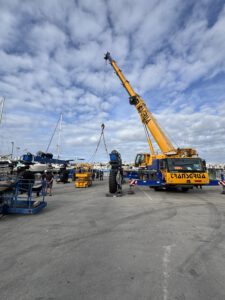
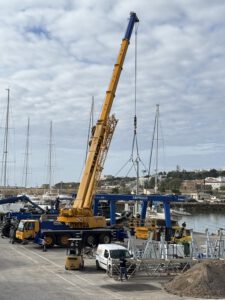
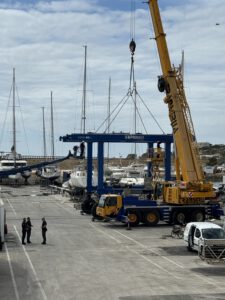
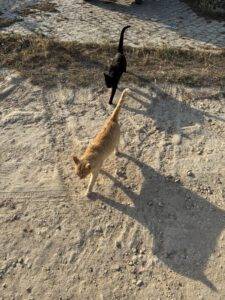
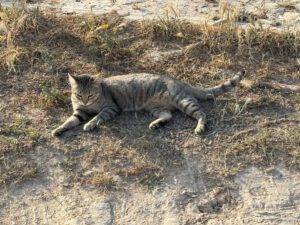
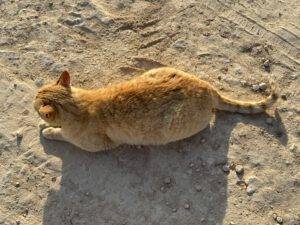
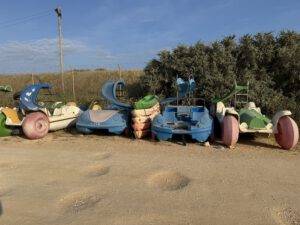
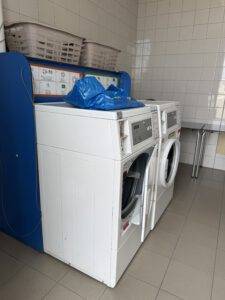
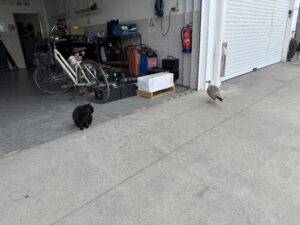
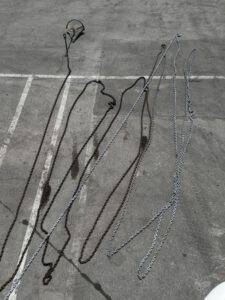
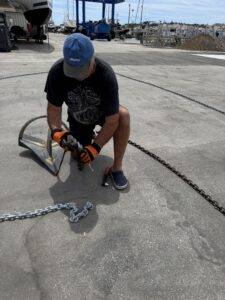
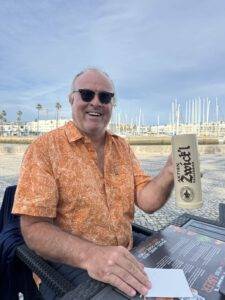
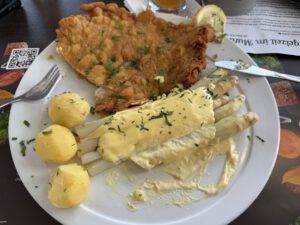
May 1st, Labor Day. It’s a holiday in Portugal too, so there’s no work at the shipyard today. With a few exceptions. Work continues on the new crane, and piles are being driven into the harbor basin. I take advantage of the washing machine on shore again and tackle the mountain of laundry. At the laundromat, I come across a little sparrow that seems to have lost its way on its first attempt at flying. Luckily, I’m able to catch it quickly and set it free. As I do so, I notice a seagull—which appears to have broken a wing—sneaking into one of the workshops and tucking into the shipyard cat’s food. The cat doesn’t seem to mind, and the seagull might just have a chance of survival this way. Back on board, we tackle the dishes. Since we’re ashore, we can’t simply drain the dishwater down the sink, so we collect it in a bucket. The full bucket is then lowered down by rope, and the contents are disposed of in the sewer. Afterward, we set out once again to search for leaks. Our fresh water pump is starting up again—or is it still doing so constantly? We’re losing water somewhere, or rather, the leaking water is collecting in the port bilge. It’s probably just a few drops at a time, but over time that adds up to a few liters. We lift the floorboards, inspect every hose connection, and still can’t find the source. Just to be safe, we tighten all the hose clamps and hope that this has fixed the leak. After all, since we’re on land, the water in the bilge can’t be saltwater, which would point to entirely different problems. Once my laundry is done, we tackle our anchor chain today. To do this, we lower the anchor along with the entire anchor chain to the seabed. We inspect the condition of the chain and check whether our chain counter is actually measuring the correct length. It is; we have a total of 90 m of anchor chain with a thickness of 12 mm. Since the galvanization on the section that has always been in the water while anchoring has already suffered quite a bit, we go ahead and flip the chain over as well. The part that’s still well-galvanized goes on the anchor, while the rusty part is secured in the anchor locker with a safety line. Then the chain and anchor come back on board, and we’ve earned ourselves a cold beer. In the evening, we head to Restaurant Munich with Dirk. Not only did we get a 10% discount card, but it’s also Asparagus Week. We’ve got to take advantage of that! We all agree on asparagus with Viennese-style schnitzel, potatoes, and hollandaise sauce, and enjoy some delicious German beer with it. Even though the asparagus is supposedly from Germany, it doesn’t hold a candle to the good Lower Saxony asparagus of yesteryear. But, you take what you can get. In the end, it was delicious anyway.
Saturday starts off slightly cloudy. Work begins at the shipyard at 8:30 a.m., but nothing is happening here just yet. So we can take our time having breakfast and showering. Meanwhile, our planned three-day stay at the shipyard has already turned into two weeks. And there’s still no end in sight. At least our package has arrived at the export parcel center and is now on its way to Portugal. By the way, Lagoon hasn’t responded at all—let alone apologized—for shipping it to the wrong location. Mistakes can happen, but no response at all? Well… Never mind, we’re getting back to work. Our water line repair seems to have been successful, since the pump hasn’t kicked in again. So we were able to drain the bilge, which had been completely flooded. During one of our last shopping trips, we bought more pool noodles and are now using them to further prop up the mast. Unfortunately, we can’t tell yet if it helps, because there’s no wind and, thankfully, La Ola isn’t rocking at all while ashore. Just in case, though, we also have another pool noodle in reserve. Next up is installing a switch and the corresponding wiring. We want to make our AIS—the signal we transmit so others can see our location—switchable on and off. Usually, we’re happy to be seen, of course, but there are also regions where we don’t necessarily want to attract attention. No sooner said than done, and after a short while, this project is also complete. Another project, the so-called “beer-on-bridge” switch, however, has to be postponed for now due to a lack of a suitable switch. Instead, we head to the Pingo Doce supermarket and stock up on some fresh groceries. And then it’s time to wait. Wait and wait some more. We’re waiting to see if La Ola will be raised as announced. The end of the workday is approaching and nothing is happening. The Crocodile, or rather the CrocLift, which is supposed to move us, is being moved back and forth. But unfortunately, only under other catamarans. So we’ll have to be patient until Monday before we can finally move a little further. At least the sun is shining, and we can kick off the evening with a cool glass of rosé. There are definitely worse things, but I think I’m repeating myself again.
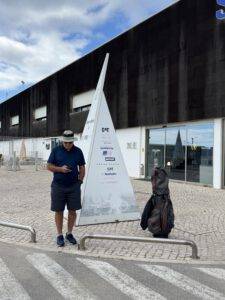
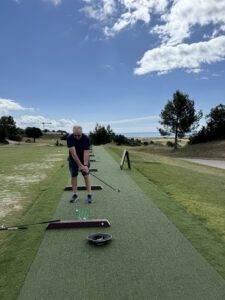
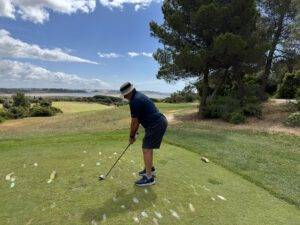
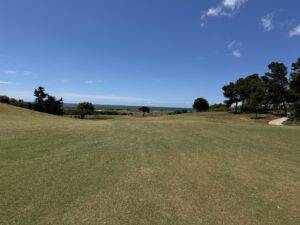
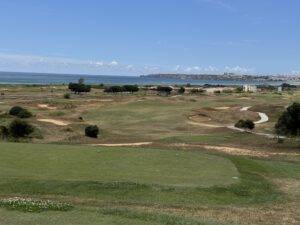
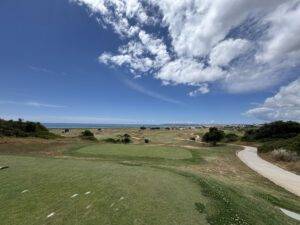
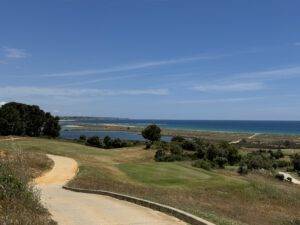
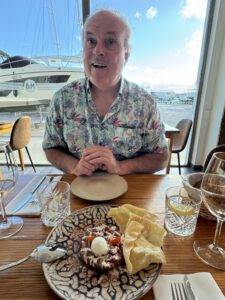
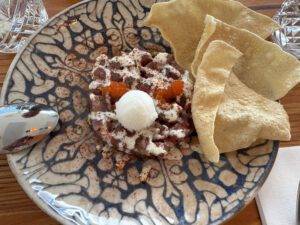
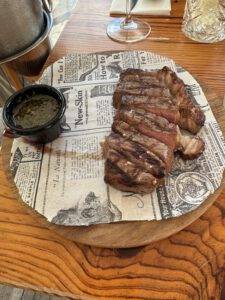
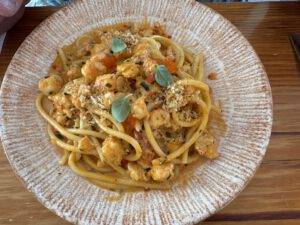
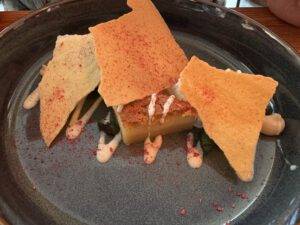
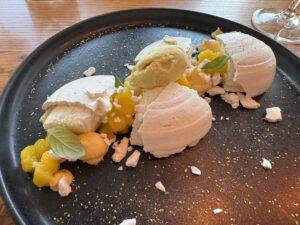
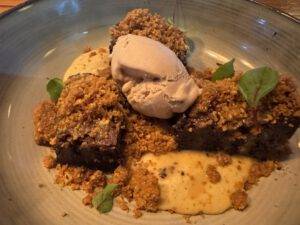
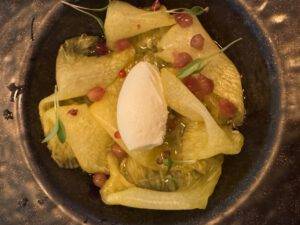
The next day, we finally have a leisure activity on the agenda. Back in March 2025, Axel played the Palmares Golf Course with our friend Stephan while I was working on board. Since both of them were very enthusiastic about the course, a return visit has been on my leisure to-do list ever since. The course is right next to Lagos, and we’ve booked a tee time for late morning. Since we don’t have a rental car right now, we take an Uber to the course. Since the course is quite hilly, we treat ourselves to a buggy and drive it to the driving range first. After all, we haven’t held a golf club in months, so a few practice swings can’t hurt. While I get the hang of it again after a few swings, it’s the opposite for Axel. At first he hits like a pro, then nothing works at all. We finally tee off with a Swiss couple and all struggle more or less our way around the course. The first nine holes make up for the mixed play with great views of Lagos Bay and Meia Praia. On the back nine, we grow increasingly frustrated and can’t even find much to enjoy about the course visually. The Praia course winds through the dunes; every other ball lands somewhere in the completely unplayable weeds, and unfortunately, there’s no nice view to speak of either. We can only enjoy the beautiful view again on the clubhouse terrace and are glad we had such nice playing partners. We take an Uber back to the shipyard, where we treat ourselves to dinner today at the MoB restaurant, which just opened a few days ago. We can enter directly from the shipyard grounds through the back door and are the only guests at first. So we have the full attention of the service and kitchen teams. We start with an exceptionally delicious tuna tartare. Super-fresh tuna with wafer-thin diced bell peppers, finely sliced red onions, and well-balanced spices. As a special touch, the tartare is topped with a small scoop of lemon sorbet, which perfectly rounds out the flavor. We continue with a perfectly grilled steak with chimichurri sauce for me and pasta with seafood for Axel. Both are equally delicious! As a special treat after a hard day of golf, we treat ourselves to dessert to finish off the meal. Axel gets a white chocolate creation with candied pistachios, while I indulge in a creatively interpreted pavlova with mango, pistachio, and curry ice cream. By now, the restaurant has filled up, and we slip out the back door and walk 50 meters back to La Ola. It’s extremely convenient to have a restaurant just around the corner. And truly a complete surprise in terms of the quality and creativity of the cuisine. We certainly wouldn’t have expected this on a shipyard site.
Monday starts with nothing. Our package containing the oar bearings is stuck somewhere between Lahr in the Black Forest and Portugal. And the shipyard workers haven’t shown up to finally take our oars apart either. Instead, Decathlon has contacted us to say we can pick up my repaired or replaced kayak bottom. Now we just have to figure out how to get to the store in Portimão. Rent a car again or take an Uber? We’ll wait and see when our package is finally ready for delivery and we can finally expect to get back in the water. So while we wait patiently, our freshwater pump starts humming again. Darn, there must still be a leak somewhere. In the extensive water system with its countless connections, it’s not that easy to find. So Axel decides to start by checking the water pump itself. It has a pressure equalization tank, which Axel suspects contains too little air or is even losing air. So we add a little air using the bicycle pump. Unfortunately, the humming starts up again after a while. We rack our brains trying to figure out where else the problem might be. Maybe it’s the hot water boiler? It’s turned off at night, and maybe the pump just needs a little time to equalize as the water cools down? After all that searching and thinking, we’ve had enough by evening and plop down in front of the TV. Star Wars Part 103 or something.
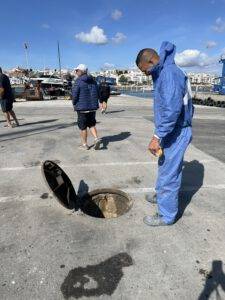
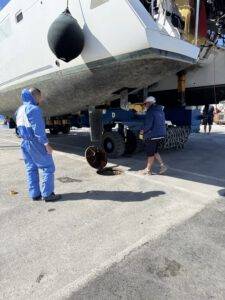
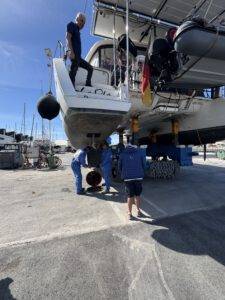
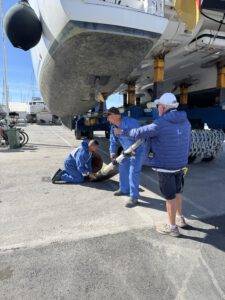
The next morning, we’re just sipping our second cup of coffee when something suddenly happens. The Croclift is lowered under La Ola, and we barely manage to climb down the ladder before we’re swept along. First, they try to pull the oar blades into place. That doesn’t work, though, because the lift’s supports can’t be raised high enough. Then they look for a solution to get the rudder out after all. Finally, a sewer shaft is opened, measured, and then La Ola is driven over the shaft with the rudder. This works for the port rudder, but not for the starboard rudder, since an electrical box is in the way. So next, La Ola is driven over an edge on the slipway, and the second rudder blade can be lowered there as well. La Ola then gets an immediate power wash of the hull, which can soon be given a new coat of bottom paint. After two hours, La Ola is securely moored in a new spot, and we can get back on board. Unfortunately, the coffee has gone cold in the meantime. Lucky slept through the whole operation in his favorite spot and didn’t even notice that he was being moved back and forth. After a short breather, we can tackle our postponed switch project today. Axel had already installed a “beer on deck” switch on Hello World. With this switch, you can trigger an audible signal in the salon from the helm, signaling that you need something. Of course, this also works if you’d like to have a cold drink brought to you. The actual purpose, however, is that this way you can quickly call for help without leaving the helm. For example, if the weather deteriorates drastically at night and the sails need to be reefed. Or if critical collision courses with other ships need to be navigated. The switch has now been delivered, so we’re moving on to installing it in the helm panel. This involves running cables and drilling holes. As is almost always the case with this kind of work, our barbecue tongs come in handy again as an extension for gripping the cables. In our opinion, a pair of large barbecue tongs is definitely an indispensable tool on every boat. In the meantime, the delivery status of our package has changed to “delivery on Wednesday.” This gives us hope that we might be able to get back in the water on Thursday or Friday. We’re following up once more with the shipyard regarding our antifouling paint job and hope that work can begin immediately. Given the current dry and warm weather, the painting should actually be completed without any problems within two days.
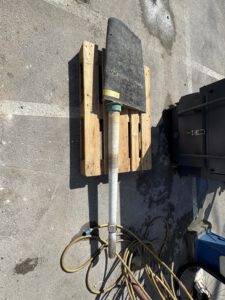
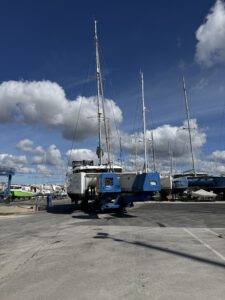
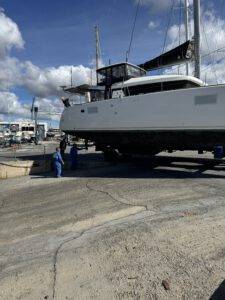
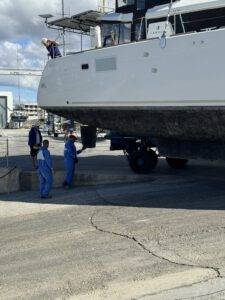
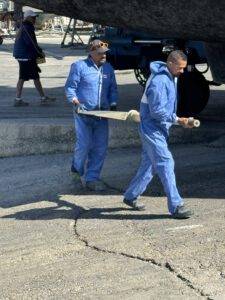
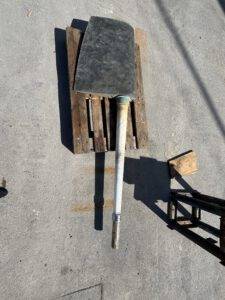
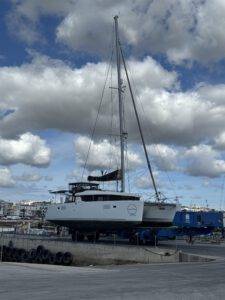
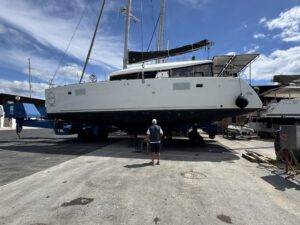
Well, all that pushing and shoving didn’t do much good. The morning at the shipyard is bustling everywhere, but once again, nothing’s happening on our end. We leave the boat in the morning and head out in a rental car to explore the area. First stop—Decathlon. After some searching, they give us a new kayak floor. It’s a newer model with seams that look significantly thicker. As always, we pick up a few other things at Decathlon and pack everything into our Ford Puma. Next, we head to Intermarché, Auchan, Aldi, and Lidl. A major grocery run in the hope that La Ola will be back on the water soon. Back at the boatyard, however, nothing has changed with the boat. And our spare parts package is unfortunately floating around somewhere in limbo. The delivery date of Wednesday is no longer feasible. We go back anyway to nag them about the underwater paint job and get a promise that they’ll start the next day.
At least we can’t complain about the weather. The sun is shining, and it’s already pleasantly warm in the morning. However, the weather is expected to take a turn for the worse over the next few days. Unusually for this time of year in Portugal, southerly winds and rain are forecast. Actually, the Azores High should be forming by now, bringing stable, sunny weather with northerly winds. Well, at least this way we don’t have to worry that, while we’re stuck on land, we might be missing one great weather window after another for the trip to Madeira. Instead, we’re hoping for a few days of steady 3–4 wind speeds from the northeast. Right on time at 9 a.m., work on the hull finally begins. First, the old antifouling is sanded down. Two men are on the job, equipped with protective gear, respirators, and a sander with a dust extractor. Our rudder bearing, on the other hand, still hasn’t arrived. The delivery date is no longer shown in the tracking information. Due to all the delays, the window for our relaunch during this spring tide has closed anyway, and we won’t be able to get back in the water until May 12 at the earliest. So, almost another week of life on land at the shipyard. I’m sure we’ll survive that too! It would be nice if we didn’t have to spend Axel’s birthday on May 14 at the shipyard. After sanding, we gave La Ola’s hull a thorough wash, and it now looks like new again. Then we masked it off and applied the antifouling. The stench is unbearable and certainly not healthy, so we’d rather get out of there. We walk to the beach and have an early sundowner at the beach bar. We probably should have had a second or third drink, because when we return, only one hull has been painted. So we retreat to the salon and try to ignore the smell as much as possible. Not easy, but Axel is fighting back with garlic in his guacamole. Eventually, work wraps up and we can venture back outside. Phew! We enjoy the guacamole with tacos and salsa. We’re joined by Janis from the Heima, whose mast project is slowly nearing completion. Next Monday, he’s finally set to get back in the water. We’re keeping our fingers crossed that everything goes smoothly.
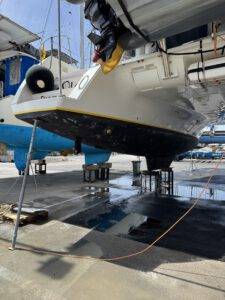
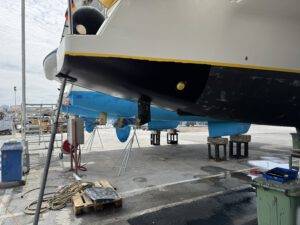
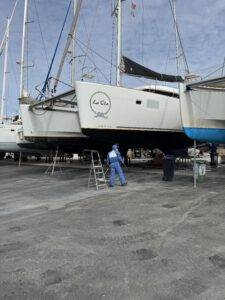
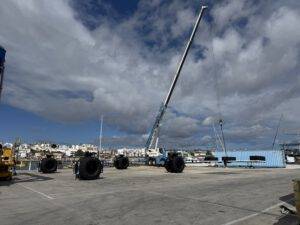
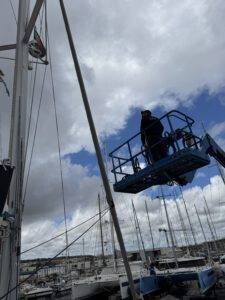
It’s now been three weeks since we’ve been ashore in Lagos at Sopromar. Once again, it’s clear that as a sailor, you can make plenty of plans, but you usually end up having to change them just as much. The idea of sailing up north before our trip to Madeira—and perhaps enjoying the Galician rias one last time—has since fallen by the wayside. Well, then maybe we can just enjoy Porto Santo and Madeira a little longer. And enjoy the beautiful Algarve a bit beforehand. Work gets off to a slow start in the morning. And Axel first has to make it clear that we don’t agree with how the work on the port side of the hull is being done. With the antifouling being used, there has to be at least a six-hour wait between the first and second coats. Unfortunately, that wasn’t done; instead, they painted the coats right one after the other. They claim they always do it this way and haven’t had any problems so far. That may be true, but if we’re thousands of miles away next year and the antifouling doesn’t deliver what it promises, they’re hardly going to refund us the—frankly quite high—price. So, please repaint it! At the shipyard, work on the new cranes continues. The “small” 60-ton crane is being put into operation for the first time. The tires for the new “large” crane have been delivered. And our eagerly awaited package containing the rudder bearings has provided a new status update. It has arrived in the Algarve! Delivery date? Still unknown! In the afternoon, a lift platform drives by our place. Our radar, which is mounted on the mast, unfortunately doesn’t show nearby targets at sea. Not good, because the radar is on board precisely for these objects—which you’d rather not ram, say, in fog. The problem can be quickly solved with the help of two plastic washers. Now the radar no longer points upward, but rather downward. Meanwhile, Axel is working on another improvement for the upcoming night voyages. So far, our deck light can only be turned on from the control panel in the salon. In situations where you quickly need light on deck at night, this is less than ideal. Therefore, a switch is being installed at the helm and wired in parallel. Now both options are available. Below deck, sanding and painting continue. In the afternoon, it’s the rudders and sail drives’ turn. The paint on the rudder shafts had already started to peel in places, so we’ve commissioned a new coat of paint. After the rudder blades and shafts are sanded down, they’re taken to one of the workshops to be painted. Just as we finish work for the day, it starts to rain, just as predicted. We retreat to the saloon, fry up some rösti with salmon, and spend a cozy evening in front of the TV.
All night long, the rain pelted the deck and the wind howled through the rigging. But luckily, the sun is shining again this morning. So we start with a delicious breakfast in the cockpit. Although it was announced yesterday that they planned to apply the second “proper” coat of antifouling today, unfortunately no shipyard employee shows up to see us as the day goes on. And our package remains stuck in its “in the Algarve” delivery status. Kind of frustrating. The morning sunshine disappears behind thick clouds, and a brisk wind blows coolly around the corners. Axel is working on a new printing project and designing a mount for our outdoor shower. We want to replace the old showerhead—which is nearly impossible to operate with wet fingers—with a larger garden spray gun. This will then be conveniently mounted on the sleek frame of our solar panels so we can shower comfortably while standing. Plus, the new showerhead makes it easier to control the water flow and turn it off quickly, so we don’t waste too much water while at anchor. In the afternoon, we go out for a quick shopping trip and make it back on board just in time before the next rain showers. In keeping with the autumnal weather, we cook up a warming chili con carne for dinner and then snuggle up under a few blankets in the salon in front of the TV.
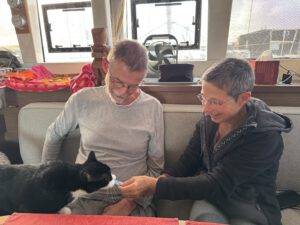
Just like the day before, it’s pouring rain at night and the wind is howling. It’s tempting to stay in bed a little longer in the morning. But eventually, you just have to get up. So I got up quickly, climbed down the slippery ladder during a break in the rain, and hurried to the restrooms on shore. Back on board, I quickly crawled back under the warm blanket until the sun came out again. Sunday at the shipyard was quiet. No grinding, no beeping from the crane, no acrid smell of freshly painted antifouling. I use the large, high-speed washing machine and dryer at the shipyard to do a big load of laundry. Sheets, throws, towels, and whatever else needs washing. Three loads later, it’s already afternoon, so I put off the rest of the laundry until the next day. In the evening, our neighbors Rita and Peter from the catamaran Dahoam stop by for a glass of wine and a beer, and we spend a nice evening chatting about sailing and diving. There are also two cats on board the Dahoam, and Lucky quickly befriends Rita and Peter. It’s amazing how trusting the shy tomcat has become. Rita and Peter will stay ashore with the Dahoam for a few more weeks, but eventually they want to head west as well. So there will surely be a repeat of this evening at some point.
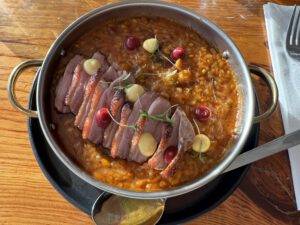
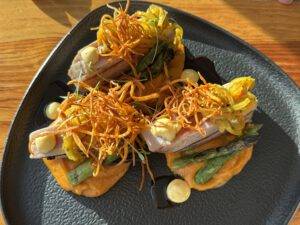
Monday is off to a busier start again. More parts for the new large crane are being delivered and arranged like pieces of a giant puzzle. Our package is actually supposed to be on its way to us, and we’re very curious to see if and when it arrives—and how quickly things will move forward from there. In any case, we’ve booked a launch appointment for the next day just in case. It would be nice if we could actually make it. To do that, once the package arrives, we “just” need to attach the rudder bearings to the rudders, reinstall the rudders, apply a second coat of antifouling to the hulls, and scrub the boat. A challenging plan! And two loads of laundry need to be done. I’ll get started on that right after breakfast, but I’m quickly interrupted again. The machines are occupied, and I have to join the waiting line. Instead, we pay another quick visit to the shipyard employee in charge of us and ask when the second coat of antifouling will finally be applied. He suddenly claims to know nothing about it, however, and says that it was painted twice. It was, but not with the proper drying time between coats. He promises to sort out the issue and speak with his supervisor. Of course, he could have done that last week. On the way back, I check again to see if the washing machine is free yet, but I’m immediately faced with the next problem. The machine is broken! OK, so I guess that’s not going to happen today. After lunch, someone actually comes by and applies the second coat of antifouling. Great—hopefully that’ll last all the way to the Caribbean. To escape the stench, we pop over to see Janis and the Heima, who are heading back into the water today. The masts are up, but it’s still a bit of a mess. So we arrive just in time and pitch in so that in an hour, when the travel lift arrives, everything is on board. The jib boom, main and mizzen booms, the two gaffs—everything is hoisted on board. Janis’s two helpers, Han and Jonathan, also lend a hand, and so after an hour, almost everything is indeed on board and pre-assembled. We help with the launch and, after three hours, are back on board just in time for the end of the workday. La Ola is finished being painted, but unfortunately our package wasn’t delivered. So we’ll probably have to cancel our crane appointment for tomorrow afternoon. In the evening, we treat ourselves to another delicious meal at the MoB shipyard restaurant and enjoy tuna fillet and duck breast.
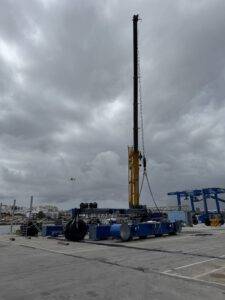
Mixed weather, the package is still on its way, and the washing machine is still broken. What do you do on a day like this?! First, take it easy and enjoy a bowl of cereal for breakfast. Shower, do the dishes, then relax again. A technician is coming to fix the washing machine, and with any luck, it’ll be working again in a few hours. Someone must have put in too much detergent. But you’re not supposed to do that—the detergent is included and is automatically dispensed. Numerous very large parts continue to be delivered for the new big crane. It’s exciting to watch it being assembled. Of course, we’d much rather have our replacement parts arrive soon so we can finally get our oars reinstalled. They say patience is a virtue, but we’re slowly getting sick of country life. At lunchtime, we ride our bikes to the hardware store for a change of pace. We still need a hose for our new outdoor shower setup, which we manage to get quickly. Then we make a quick stop at Aldi to pick up some groceries for the next few days. Much to our chagrin, Aldi has taken the delicious chicken sausage off the menu. Instead—much to Axel’s delight—they now have salty licorice fish and licorice shells in the lineup. Naturally, we stock up generously on these for the ship’s provisions. Back on board, we have a small midday snack, and lo and behold, our package status changes to “In Delivery.” Does that mean it’s arriving today? At least a small glimmer of hope. If only the washing machine would work again now! But no, that’s asking too much. After the rain of the last few days, we unpack the scrub brush again in the afternoon and clear La Ola’s deck of the dirt and dust from the shipyard surroundings. It’s pretty dirty again. But in the end, everything looks reasonably spiffy again, and we can get back to relaxing. And keep practicing our patience, because our package is still “in delivery” and hasn’t been delivered yet. According to the DHL website, it should take 4–5 business days. Unfortunately, we’ve been waiting twice as long by now. OK, a quick OM and a deep breath. The sun is shining and we’re where others usually go on vacation. No, of course no one goes on vacation at the shipyard. But on the fantastically long beach of Lagos, which we can see from our rooftop terrace. We could theoretically go for a swim there, but at 16°C, the water temperature is still a bit too chilly for us. Tonight, we’re having something from the galley again. Axel is cooking delicious Asian chicken with crunchy peanut sauce. Mmm! And—oh, a miracle and the highlight of the day—the delivery status of our package has changed to “delivered”! Yippee!!! Hopefully things will move quickly tomorrow, and we’ll finally be back in the water soon.
Full of anticipation, we wait for the mechanic the next day. We wait and wait and wait. Nothing happens. Supposedly, he just has to finish one more job on another boat and then he’ll take care of us. But when we check in at noon, unfortunately no one knows when that will actually be. So we try to be patient once again, but it’s even harder now. Of course, we realize that just because our replacement parts have finally arrived, they can’t just throw the shipyard’s entire work schedule out the window. But surely they could squeeze us in somewhere? Or at least start the preparations? Or give us a reliable date? No chance—nothing is happening. So we use the extra time in Lagos to stock up on drinks once more. We head to Lidl on our bikes with two panniers and return fully loaded. In the afternoon, thankfully, the washing machine is finally repaired, and I can quickly take care of the rest of the laundry. You’ve got to have a bit of luck sometimes. Although I’m stuck in the queue again today, and the wash cycle drags on endlessly. The woman who did the pre-wash didn’t take her laundry out of the machine on time and then forgot to turn on the dryer she’d loaded. No problem, because patience has become my middle name. And besides waiting, we don’t have anything else to do anyway.
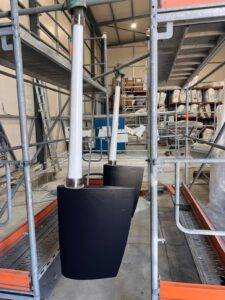
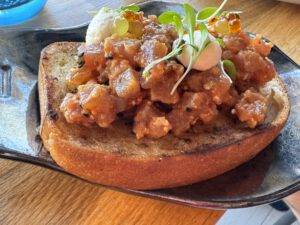
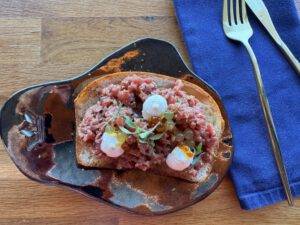
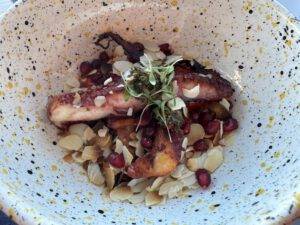
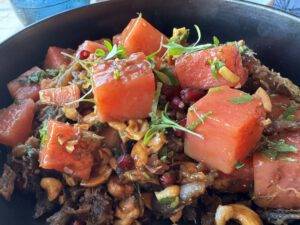
May 14, 2026—what a great day! It’s Axel’s birthday, we’re having a fantastic breakfast of eggs and croissants, and the sun is shining brightly. And it’s Father’s Day, too. In Portugal, however, that’s not a holiday. Still, we’re not making any progress on the rowing work. The mechanic won’t have time for us until the afternoon at the earliest, but probably not until tomorrow. To help us plan a little better, we’ve also decided in the meantime that we don’t want to get back in the water until next Monday. That’s because our guests have announced they’re coming for the weekend, and we’ll be reliably in Lagos—not potentially anchored somewhere else. Our friends Marcie and David have booked an apartment near the marina, and we can enjoy two relaxing days together before they fly back to the U.S. So we can show them a bit of the beautiful Algarve, we’ve also rented a car again for Sunday. With this new plan, we can now be much more relaxed and patient. After breakfast, we head out on our bikes again. I’ve discovered a Dutch-Scandinavian mini-market around the corner, which we’re now browsing through. There are some treats, like Abba Sild, bitterballen with Old Amsterdam, remoulade sauce, and licorice in numerous varieties. Unfortunately, they only accept cash, so our shopping selection is unfortunately limited. Back on board, we enjoy a delicious birthday champagne—the last bottle from Champagne that Andrea and Pit brought us in the fall of 2024. Just before closing time, the chief mechanic stops by and returns our modified rudder blades. Although we’ve always been told that the rudders would need to be installed to determine whether the new rudder bearings fit or if the rudder stock might be worn out, we’re now pleasantly surprised. The mechanic has a short piece of test rudder bearing with him and can thus test it without needing to use the crane again. However, it quickly becomes clear that the shaft is indeed worn out—in other words, too large for the new rudder bearing. So the shaft must first be narrowed with epoxy so that the rudder bearing can be installed. Well then, we’re in no hurry. In the evening, I treat Axel to a nice birthday dinner. We walk into town and try out a new restaurant. The small restaurant Irreverente has only five tables, and we’re lucky to snag a spot. And once again, we’re pleasantly surprised! The menu is small, but the dishes are carefully selected. We opt for tuna tartare and beef tartare as appetizers and experience a burst of flavor with tiny lime and piri-piri caviar pearls. Then we move on to slow-cooked octopus with chimichurri for Axel and a watermelon salad with crispy duck for me. Both are absolutely delicious! To finish, we share a chocolate mousse with almond and orange crumble. A real treat! We wash it all down with a delicious bottle of wine and roll home. A very successful way to end the birthday.
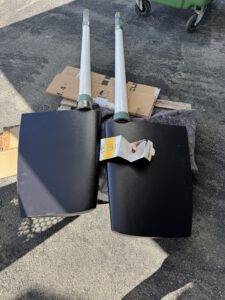
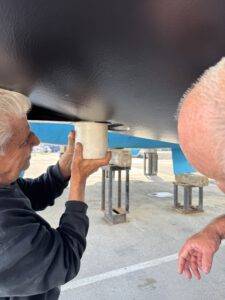
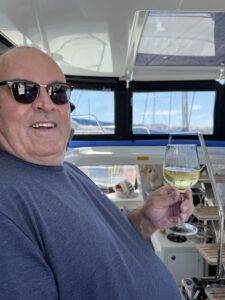
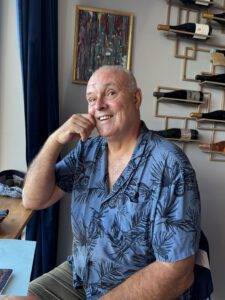
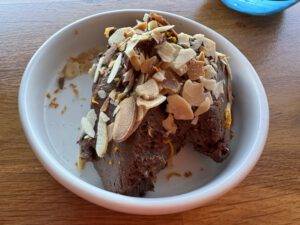
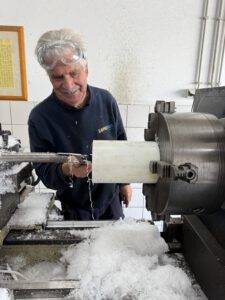
The next morning, we’ll pick up right where we left off at 9 a.m. with our rudder bearings. The chief mechanic has now suggested that he’d rather make us a new, perfectly fitting rudder bearing. That would be faster than laboriously building up layers of epoxy and, after it dries, repeatedly testing to see if the bearing fits. Well, weren’t we already at this point four weeks ago?! Back then, the line was “no time, takes too long.” Now there’s time, and the new bearing can be made quickly. It’s even supposed to last longer than the original replacement part, and the whole process is supposed to be cheaper than building it up with epoxy. Oh well. So we waited a few weeks for replacement parts that we don’t even need now. But they won’t go bad and will go into our spare parts box. That way, we’ll be well-equipped in a few years. The first new rudder bearing is made from Delrin this morning and then installed right away. By the way, Delrin is a high-performance plastic characterized by exceptional dimensional stability, low friction, and metal-like durability. Meanwhile, we spend the day doing some light polishing, shopping at the local yacht supply store, and planning the next few days—sightseeing and anchorages for the coming week. By the afternoon, the second rudder bearing is also ready and gets installed. The bearings are lightly glued in place, and to ensure they sit correctly and can dry there, we bring out the CrocLift right away. La Ola is lifted, driven to the ramp, and the rudder blades are installed. So hopefully nothing stands in the way of launching on Monday. Unless the CrocLift breaks down. It suddenly starts leaking hydraulic oil while driving. But let’s not be so pessimistic! In the evening, we’re invited to the Dahoam for a return visit and spend another very nice evening together. The two cats, Floki and Kato, are also happy about our visit and the treats we brought. Only Lucky is visibly upset when we’re finally back on board, because we fed and petted the other cats.
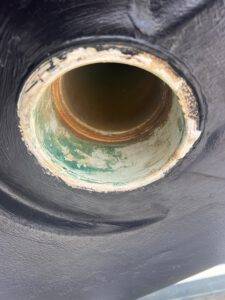
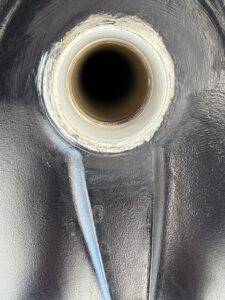
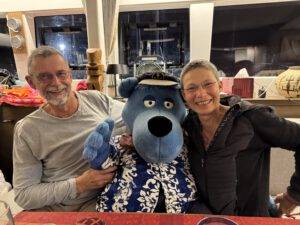
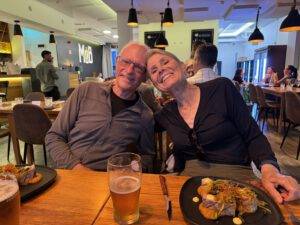
Finally, the weekend! Work at the shipyard continues on Saturdays, so we’re woken up in the morning by the hum and beep of machinery. We’re up early, of course, and can get started on our daily tasks. Today’s morning plans include a visit to the fishing shop. We ride our bikes up the hill in Lagos to Nautimar. There, we pick up a gaff and some new bait. On our way to Madeira and beyond, we’d finally like to catch a nice fish again. That’s why we’re getting bait suitable for sea bream, mahi-mahi, and tuna. We plan to haul the fish aboard using the gaff, a metal rod with a curved end. We quickly head back on board, and then we’re off on foot again. We walk to the nearby bus station and pick up our friends Marcie and David. We met 18 years ago in Panama and last saw each other 17 years ago in New Zealand. Yet it feels as if no time has passed. Sure, we’ve all aged a bit, and Axel and I have put on a few extra pounds. But the conversation and camaraderie pick up almost seamlessly where we left off. We take Marcie and David to their apartment and then enjoy a delicious midday snack at the Pearl food truck. Then we each take a little siesta before meeting up again in the evening. Unfortunately, all the beach bars are already closed, but instead we end up back at the Werftrestaurant, where we’re now greeted like regulars. We enjoy tuna fillet, seafood ravioli, and a tuna sandwich. For dessert, there’s chocolate cake, white chocolate, and pineapple carpaccio. As always, everything is delicious and the perfect ending to a lovely evening.
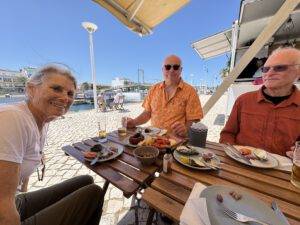
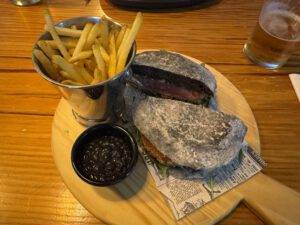
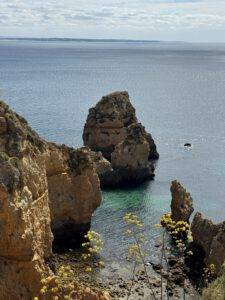
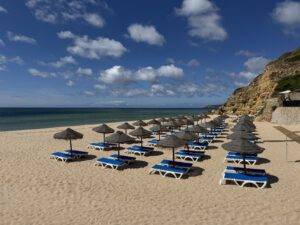
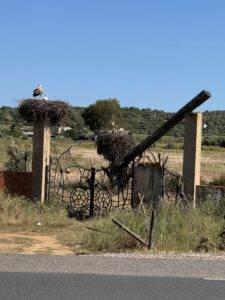
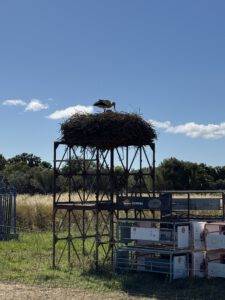
On Sunday, we voluntarily get up even earlier. We meet up with Marcie and David at 8:30 a.m. and head to Café Alex for breakfast together. Afterward, we pick up our rental car and set off on our tour along the Algarve. Our first stop is Ponta de Piedade, which, as always, enchants us with its stunning views. We continue along the coast to Salema. Despite the gorgeous weather and crystal-clear, azure-blue water, the beach is completely deserted. Next stop: Cabo São Vicente, essentially the closest point on mainland Europe to Marcie and David’s home in the U.S. The number of tourists has increased dramatically since our last visit, so after taking in the panoramic view, we quickly head back west. We drive to Ferragudo and stop for lunch at Club Nau. Here, too, we are once again not disappointed, both by the food and the lovely view of the water. We continue on to Carvoeiro, where we take a short walk along the Algar Seco and enjoy the Algarve’s unique coastal landscape. Finally, we head back to Lagos. On the way there, we stop at the stork colony in Odiáxere as our final highlight. Of the hundreds of stork nests, nearly all are now occupied by chicks, which should soon be ready to fly. Back in Lagos, we treat ourselves to a short siesta before meeting up again in the evening aboard La Ola for a glass of wine and snacks. After many lively conversations, another beautiful day and evening finally come to an end.
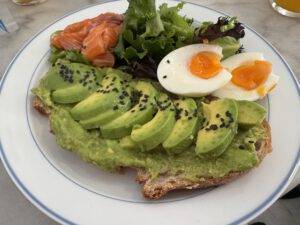
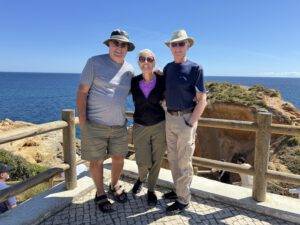
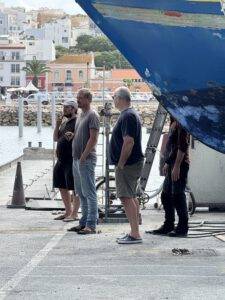
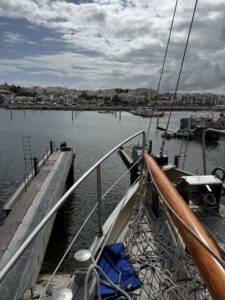
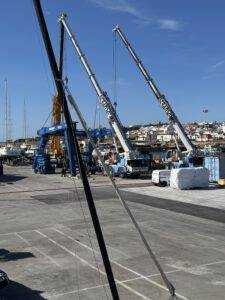
Monday. The last day after 4 1/2 weeks ashore. Marcie and David visit us one last time for breakfast together before they head to Lisbon and from there back to the U.S. We promise each other that we won’t wait another 17 years for our next meeting and hope to see each other again soon. Meanwhile, work on our oars continues and is finally successfully completed. The oars are firmly in their wells and are connected to the tiller again (and are moving parallel to each other once more!). After Marcie and David have left, we tidy everything up. The bicycles are cleaned, the aft deck scrubbed, fresh food stocked up for the next few days, and another load of laundry washed. Meanwhile, under La Ola, they’re working diligently on the CrocLift and trying to fix the hydraulic oil leak. And work on the large travel lift is also progressing briskly. Using three cranes, the upper section is being placed onto the lower section today. We pay our rather hefty bill, say goodbye to everyone, and are actually picked up by the repaired Crocodile in the afternoon and launched into the water. Everything is watertight, the engines are still working, and we’re allowed to stay at the dock for one more night. We quickly tidy everything up again, and we’re ready for the next adventure!
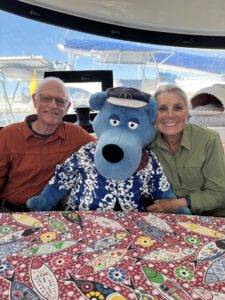
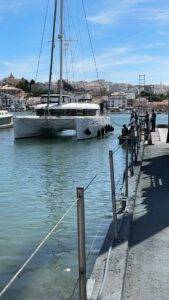
Since our stay on land has turned out to be much longer than we expected, we won’t be sailing to northern Portugal as planned. Instead, we’ll stay in the Algarve a little longer and wait for a suitable weather window for the trip to Madeira. The forecast currently looks promising for the end of the month, but of course, that could still change. We’ll keep an eye on it and stay patient!