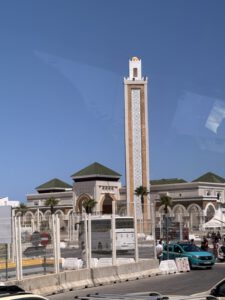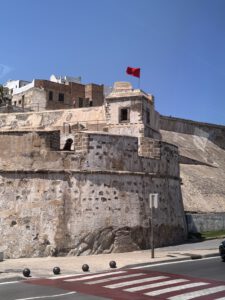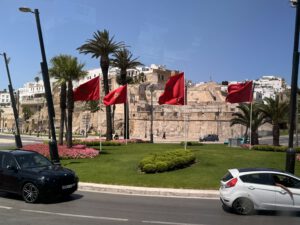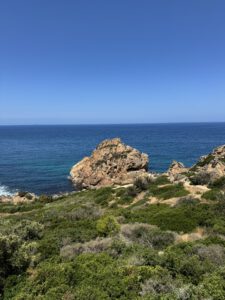
We booked a day trip to Tangier, Morocco, through Get-your-Guide at the end of June 2026. We’re happy to share our varied—and not entirely uncritical—impressions here in a separate blog post.
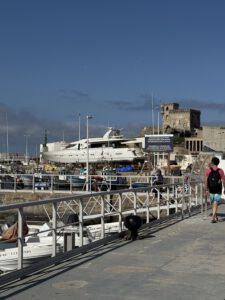
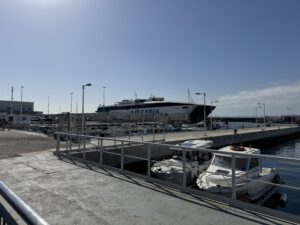
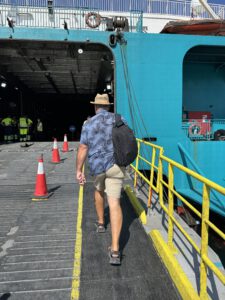
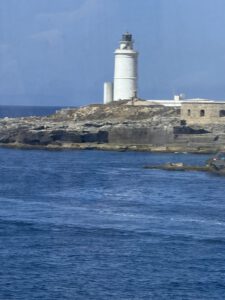
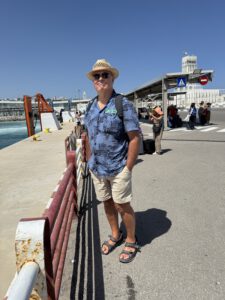
The day before, I received a call informing me that we would be picked up at Marina Puerto America the next morning at 8:20 a.m. So our alarm went off extra early on Saturday. After quickly drinking a cup of coffee, packing a few bottles of water and some snacks, a WhatsApp message popped up saying they were waiting for us at the marina entrance. But it was already 7:45 a.m. We weren’t ready that quickly, so we weren’t ready to leave until 8:00 a.m. A taxi was waiting for us, and we managed to figure out in broken Spanish that we’d first be driven to a pickup point and then transfer to a bus. So we set off at breakneck speed to Puerto Real, where we were dropped off at the Gran Hotel Ciudad Del Sur. However, there’s no sign of a bus anywhere. So we wait in the hotel’s rather uncharming lobby for half an hour until a small tour bus finally shows up. We get on and drive along country roads to Medina-Sidonia and from there, also through the countryside, to Vejer de la Frontera. It’s a slight detour compared to the direct highway route, but the scenery is nice to look at. In any case, Medina-Sidonia is already going on our list of places to visit next week. We’re already familiar with Vejer from last year. We pass numerous herds of cows and bulls of the Andalusian Retinto breed. According to our tour guide, these magnificent bulls are used in bullfighting and have truly impressive horns. Around 10:20 a.m., we finally reach Tarifa on the Strait of Gibraltar. Our high-speed ferry is already waiting at the port; it’s actually scheduled to depart at 11 a.m. Before we board the ferry, however, we have to take care of a few formalities. We’re handed our ferry tickets and a form for entry into Morocco. Then we go through ticket inspection, passport control, and a security check. Just like at the airport, our luggage is X-rayed and we’re scanned. It’s not until after 11 a.m. that we’re finally on the ferry, and around 11:20 a.m. we finally set sail. Traveling at about 30 knots, we cross the Strait of Gibraltar toward the African continent. We pass the Isla de las Palomas lighthouse on Isla de Tarifa, which marks the European boundary between the Atlantic and the Mediterranean. Unfortunately, there’s no way to enjoy the crossing outdoors on board the high-speed ferry, so we sit inside. To enter Morocco, we also have to go through passport control and get our passports stamped during the crossing. So half an hour of the trip is spent waiting in line and dealing with other formalities. Surprisingly, we arrive at the port of Tangier at 11:20 a.m. OK, a one-hour time difference explains the quick trip! We walk ashore and our passports are checked to make sure they’re stamped. Then we have to go through another security check with a baggage scan. Maybe we could have smuggled something into our luggage during the trip?!
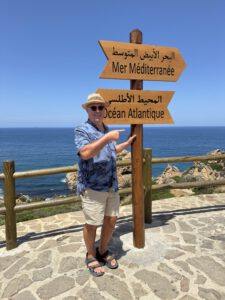
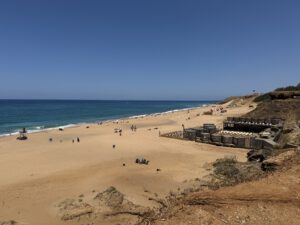
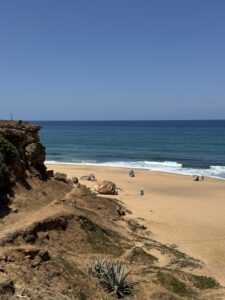
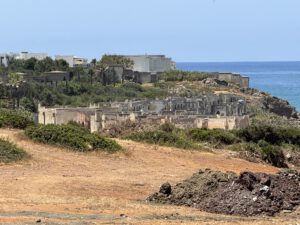
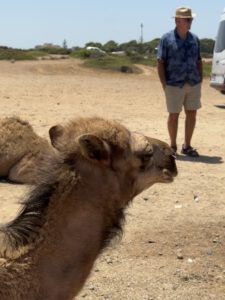
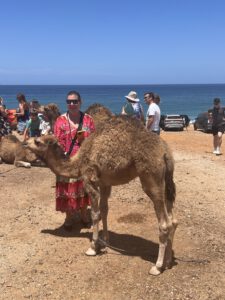
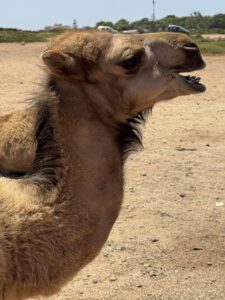
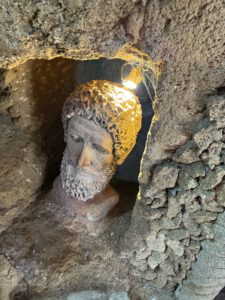
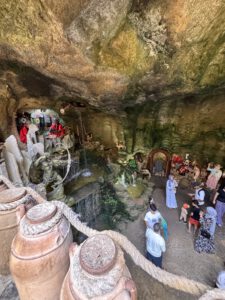
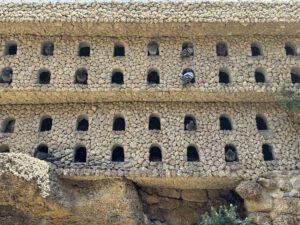
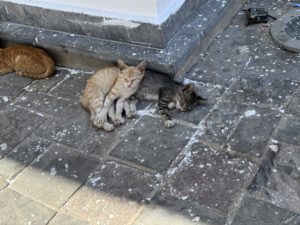
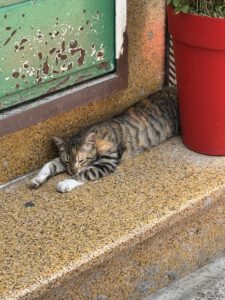
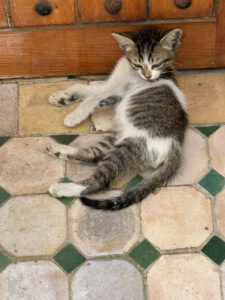
Around noon, we were ready to go, and our local tour guide, Rachid, ushered us onto a waiting tour bus. We head west along the coast toward the outskirts of Tangier. We’re supposedly passing by King Mohammed VI’s summer residence and the Saudi Arabian king’s residence, but first of all, you can’t really see anything, and second, the official residence, Dar el-Makhzen, is actually located somewhere else entirely in Tangier’s old town. But who knows—maybe the king just has a few different little houses? We finally stop at a lookout point at Cap Spartel. We don’t actually get to see the cape itself, since it’s located a bit further to the northeast than the lookout point, but we can take a photo here with a fancy sign marking the boundary between the Atlantic and the Mediterranean on the African continent. Too bad—we would have loved to see the lighthouse and the “real” Cape Spartel. Back on the bus, we drive along endless beaches to the next obligatory stop. Camels are part of any proper tourist itinerary in North Africa, so we stop at one of the many camel groups along the roadside. For two euros, you can take a single lap on the camels through the dust. Photos with camels are, of course, also offered. And they try to push oriental-style jewelry and knickknacks on you. We settle for taking our own photo of and with the young camels and pass on the other trinkets. Back on the bus, we drive another five minutes to Hercules’ Cave. We cross a small square and Rachid invites us into a cave. Unfortunately, however, it’s not the actual Hercules Grotto, but a smaller cave filled with all sorts of art and kitsch, where musicians are playing and photo opportunities with monkeys are offered. The only thing that looks authentic and old is the stone dovecote. The entrance to the actual Hercules Grotto is right next to it, but the rather high admission fee doesn’t seem to be included in the tour, so a visit inside isn’t even offered. It’s a shame, because we would have loved to see the cave’s opening facing the sea, which was formed by the rifts of the African continent. We walk back across the small square in the scorching midday heat, and I have to restrain myself from taking home one to three small, emaciated kittens lying flat on the stones in the midday heat. Back at the bus stop, our bus is unfortunately missing, and we have to wait a few minutes until it reappears. Fortunately, the bus stop offers a little shade.
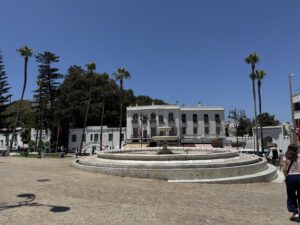
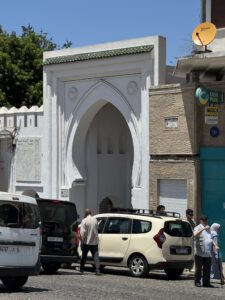
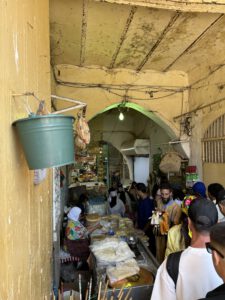
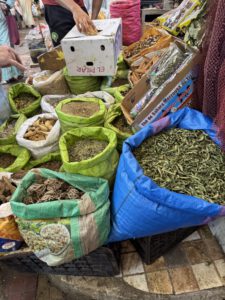
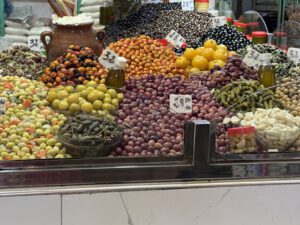
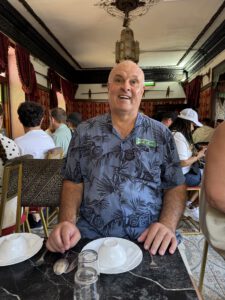
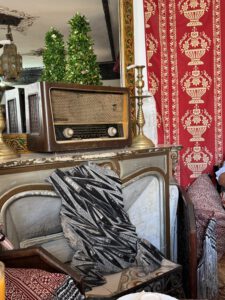
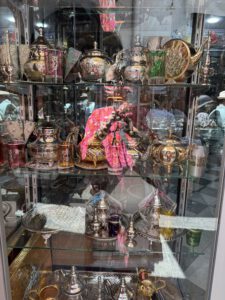
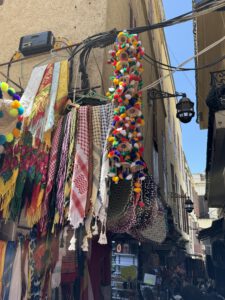
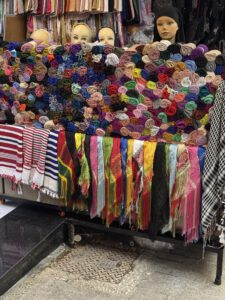
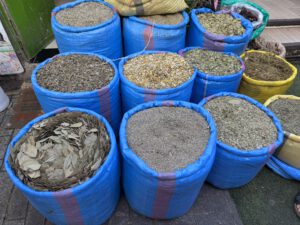
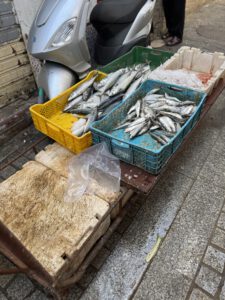
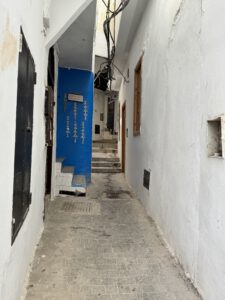
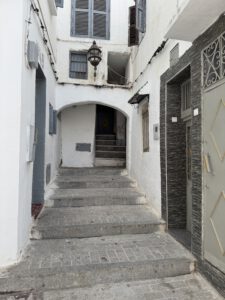
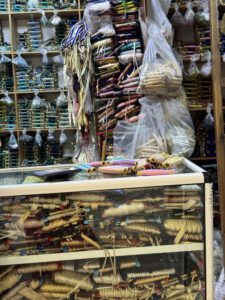
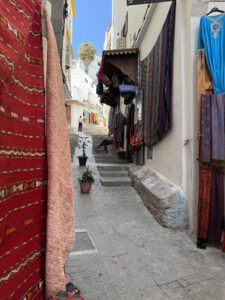
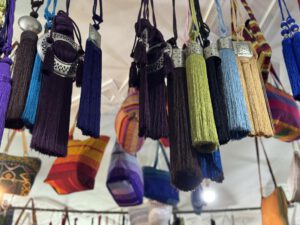
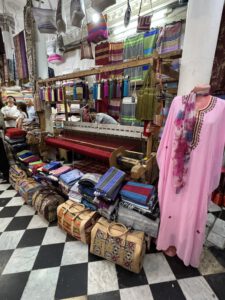
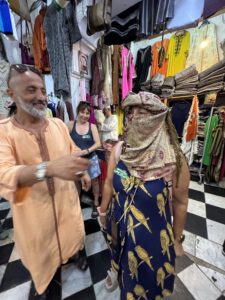
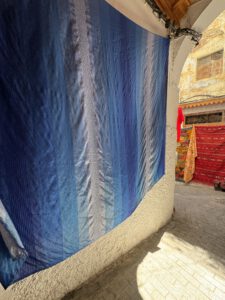
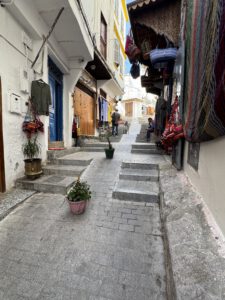
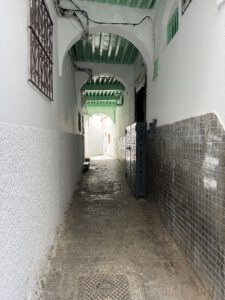
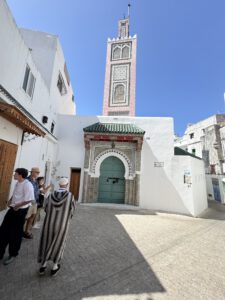
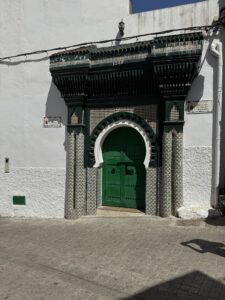
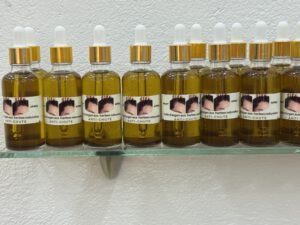
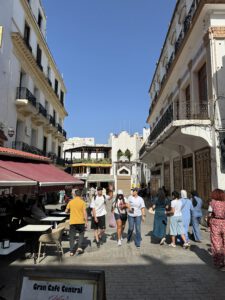
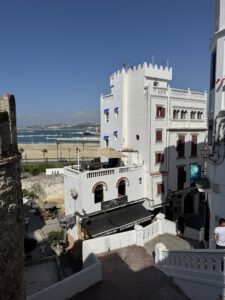
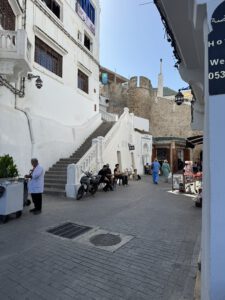
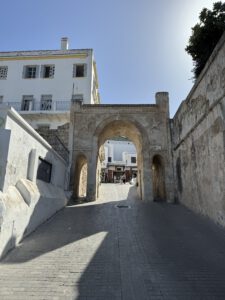
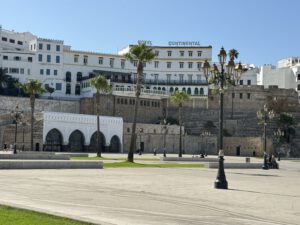
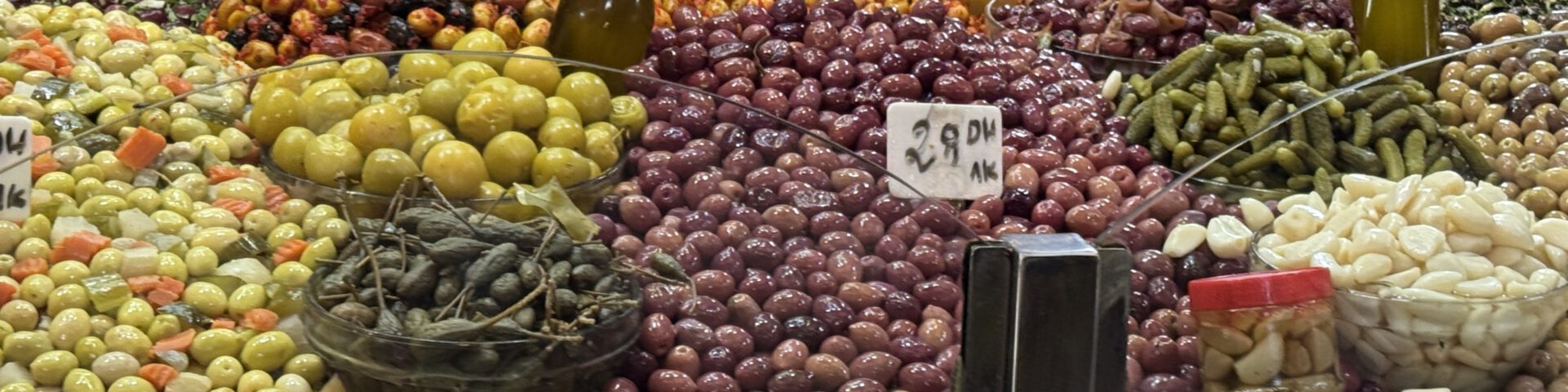
We’re driven back to Tangier along the same route and dropped off at the Grand Socco market square. Our guide, Rachid, leads us through the bazaar into the medina, Tangier’s old town. As always, we’re thrilled by the variety of goods on offer at the market and let the diverse scents of garlic, citrus fruits, and herbs waft past our noses. We finally arrive at the Mamounia Palace Restaurant, where seats have been reserved for us on the upper floor. The meal is included in the tour price. The drinks, however—despite repeated reminders—are not. We sit down in a corner with Sherry and Stefanie from California and are first served a lukewarm soup. Upon asking, the dish turns out to be a vegetable soup with chickpeas and lentils. However, what you really taste is mostly water—and the complete lack of salt. Fortunately, when we ask, we’re handed a salt shaker, and the soup at least gains some flavor. Next, we’re served small chicken skewers and couscous with chicken thighs, vegetables, and raisins. Edible, but far from a culinary delight. The meal is accompanied by traditional music that could generously be described as Middle Eastern. We find it rather too loud and disruptive to our table conversations. To finish, we’re served a shortbread cookie, coffee, or mint tea, and then we’re off again. Rachid has since figured it out and is now supplementing his Spanish and English explanations with German as well. Hats off to such linguistic talent. We zigzag through the medina, hurrying from the food section to the clothing district, back past unchilled fish displays, past small turtles for sale on a bed of lettuce, and on to the weavers’ quarter. Here we can watch a weaving demonstration and have the opportunity to purchase scarves, shawls, and blankets. We pass on the opportunity and are glad when we can continue walking through slightly better-ventilated and shadier alleys. Finally, we’re dropped off at a small square and now have about three-quarters of an hour to explore the maze of alleys on our own. However, we prefer to continue following Rachid and are led into a perfume workshop. Here, in addition to numerous enchanting scents, argan oil—a Moroccan specialty—is also offered. There are numerous varieties with different scents, neutral argan oil, and a type that’s supposed to stimulate hair growth. According to the label, though, it’s no longer supposed to help Axel, so we decide not to buy any. Instead, we buy argan oil with lemongrass to ward off mosquitoes and argan oil with arnica for bone pain and migraines. We’ll see if it helps. We’re also happy to pass on the “natural Botox” in the form of cactus seed oil. We’re proud of our wrinkles! Finally, we end up at the Gran Café Central and refresh ourselves with lemon juice and an ice cream.
At 5:00 p.m., Rachid picks us up again and leads us back to the harbor. To our great surprise, we don’t simply cross the street and walk the remaining 100 meters to the ferry terminal; instead, we’re asked to get back on our bus and driven the short distance. The procedure for boarding the high-speed ferry again is just as exhausting as it was on the way there. Ticket check. Security check and passport control with an exit stamp. This is followed by a wait, a walk to the ferry, and another passport check to verify that we’ve received our exit stamp. Once aboard the ferry, we sink exhausted into an armchair and enjoy a cold beer. The ferry departs more or less on time at 7 p.m. and reaches Tarifa two hours later. Here, too, the slow journey is due to the time zone change. We go through passport control and security checks again in Tarifa and are back on our small tour bus by 9 p.m. Fortunately, this time the driver takes the faster route via the highway and drops us off at the same hotel as this morning at 10:15 p.m. Our taxi is already waiting, and twenty minutes later we’ve arrived safely back at the marina. Exhausted from the long day, we have one last glass of wine in the cockpit before collapsing into our bunks around midnight.
Was the trip worth it? Yes and no! Yes, because we were able to get a quick and easy glimpse of the city of Tangier and soak up some Moroccan atmosphere. Transportation and organization were good, even though we would have liked some more authentic stops and better food. No, because the administrative hassle was quite significant. The time spent traveling, dealing with entry and exit formalities, and waiting took up a very large portion of our time. In our opinion, a stay of several days would make much more sense. But for a first impression, we thought the trip was perfectly fine.
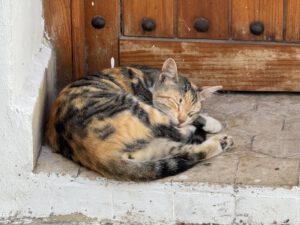
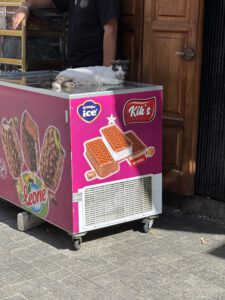
We didn’t like the numerous, very pushy vendors who constantly hounded us with cheap jewelry or henna tattoos. We also didn’t like seeing so many cats on every corner, all of which were in a more or less pitiful state. From newborn kittens in cardboard boxes by the roadside to old, emaciated cats, there was a lot of suffering to witness. Not to mention that a cat really has no business being on the ice box at the grocery store, and cat hair on a lunch plate at a restaurant is also rather problematic.