Cartagena – Caleta del Estacio outside La Manga/Mar Menor 25,3 nm

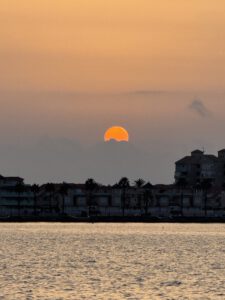
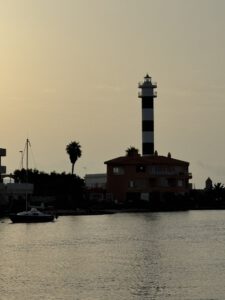
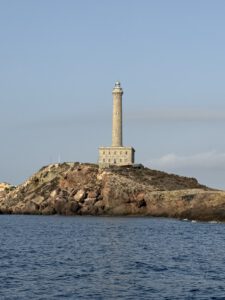
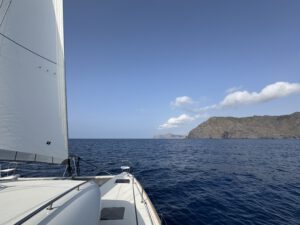
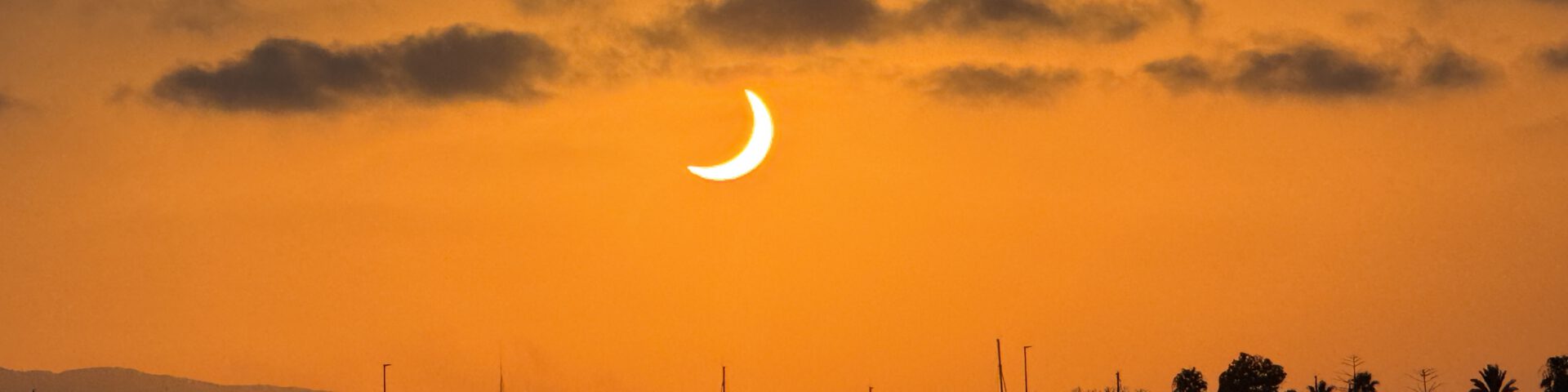
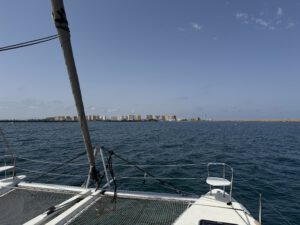
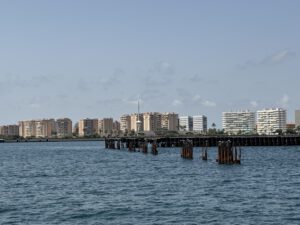
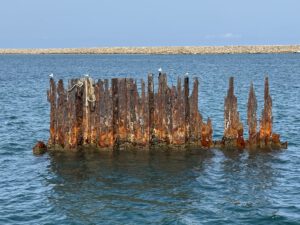
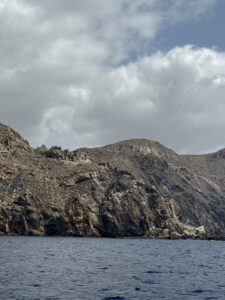
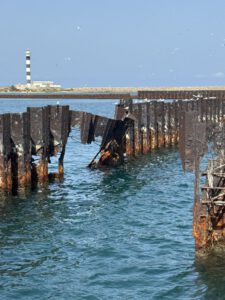
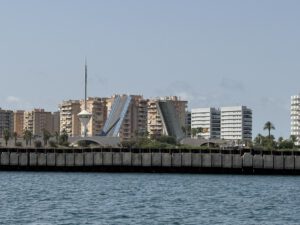
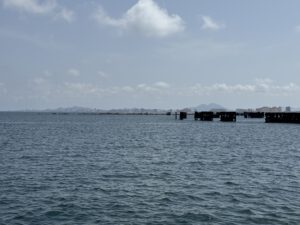
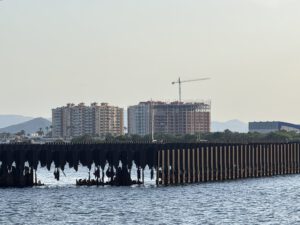
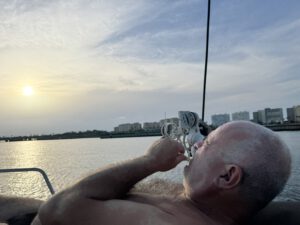
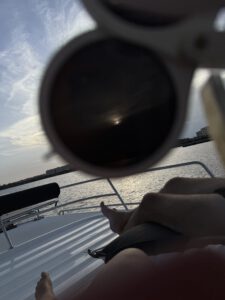
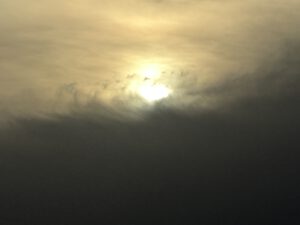
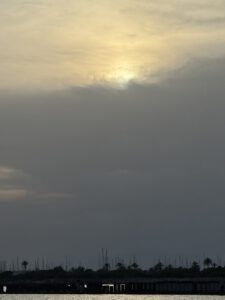
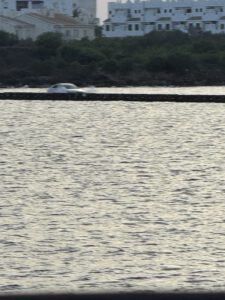
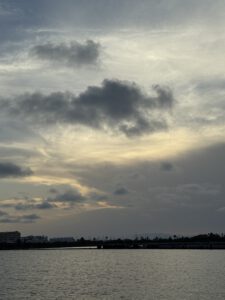
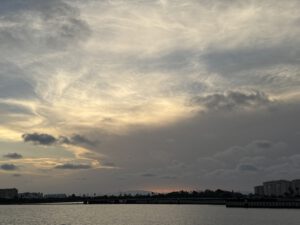
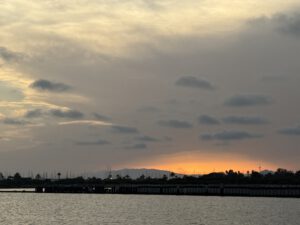
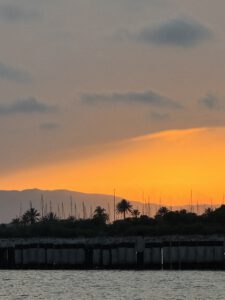
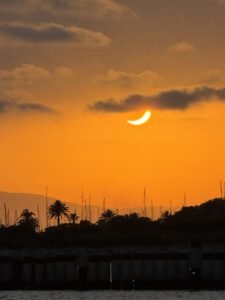
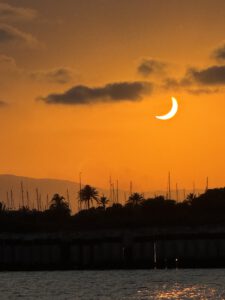
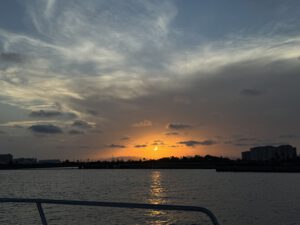
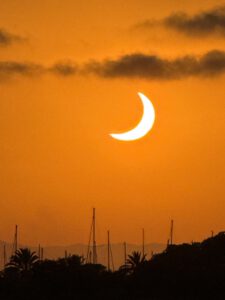
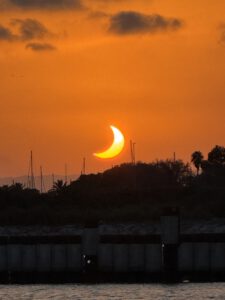
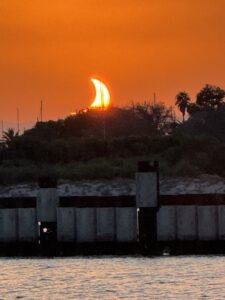
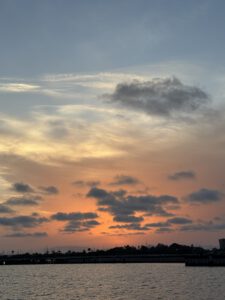
We’re leaving Cartagena for now and continuing on our way. Today, August 12, 2026, we want to secure a good viewing spot for the upcoming solar eclipse. Unfortunately, the eclipse won’t be 100% total here, but at least 97%. That’ll have to do. Before we set off, we fill up the water tanks one last time. This way, we’ll be self-sufficient for a few more days and can enjoy anchoring. At 11:20 a.m., we cast off and head out of the marina. The first highlight of the day awaits right beyond the exit. A submarine is in the harbor, moored right in front of us for good measure. It’s not something you see every day. We continue along the coast toward the northeast. The sea is surprisingly choppy. The wind and waves aren’t really in sync, so it turns into a rocky ride. We pass Cabo de Agua and Cabo Negrete. The coastline becomes less rocky and flatter, but hotels and vacation resorts start popping up. Finally, we round Cabo de Palos and turn north. The sea finally calms down, and we glide along leisurely. Unfortunately, we’re under engine power again, since the little wind there is comes straight from the front. We sail along a huge sandbar that separates the Mar Menor from the Mediterranean Sea. Unfortunately, high-rises line up one after another, forming an almost continuous skyline. It’s not exactly chic, but if you live in one of the penthouses, you certainly have a first-class view. Finally, we reach the entrance to the Mar Menor and decide to drop anchor just outside. Years ago, there were plans to build a huge marina here. The construction project was eventually halted by environmental activists, and ever since, the half-finished facility has been left to decay. The whole scene at the entrance has a somewhat surreal quality. We pass through an imaginary entrance, marked by metal posts that are almost completely rusted. The terns perched on them give the scene an almost artistic touch. We drop anchor in the vast harbor basin and find ourselves in the middle of a sheltered area. Traffic heading into the Mar Menor flows along the outside of the sheet pile wall and doesn’t bother us. We look toward the high-rises behind us and figure we should have a clear view of the solar eclipse. However, the numerous cumulus clouds in the sky are a nuisance. With any luck, they’ll dissipate by evening. If not, we’ll unfortunately be out of luck for the solar eclipse! We’ll have to be patient for a little while longer, though. The sun is expected to darken between 7:30 p.m. and 9:30 p.m. We expect the peak—with maximum coverage—at 8:30 p.m. So first, it’s time for dinner. We have a second serving of shrimp and are now enjoying them with aioli and baguette. A simple meal. In other words, it was prepared with minimal effort. Then we cool off a bit in the front cockpit before heading up to the rooftop terrace at 7:30 p.m. We pull out the sextant, turn our beanbags toward the sun, plop down, and wait eagerly. Veeeery slowly, a shadow creeps in front of the sun from the bottom right. The tension builds and then abruptly drops. A pretty thick layer of clouds wants to join in the fun and cheekily pushes its way in front of the sun. Oh well. I guess that’s not going to happen. Dusk falls and it gets dark, but there’s not much more of the solar eclipse to see. Still, the sky looks really beautiful even so. So we set the sextant aside and just lie there in our beanbags. And lo and behold, sticking it out pays off! The sun dips beneath the cloud, and suddenly we get the full show. A radiant red sky, the sun as a crescent, and palm trees instead of skyscrapers in the foreground. If you were to paint something like this, it would quickly be labeled kitsch. But nature really knows how to work its magic, and so we’re simply thrilled. And we don’t even need protective glasses. Wonderful! What do you think of the pictures? Afterward, it’s time to wait patiently once again. Because in addition to the solar eclipse, today also marks the peak of the Perseids. There’s supposed to be a shower of shooting stars. We turn the beanbags in the other direction and are ready and eager once more. While Axel disappears into his bunk sometime around 11 p.m., I stay up past midnight and get to see some really bright and long shooting stars. Unfortunately, the surrounding high-rises make it too bright to see the smaller ones. Eventually, the sky clouds over, and I head off to my bunk as well.
La Manga/Mar Menor – Illa de Tabarca 29,1 nm

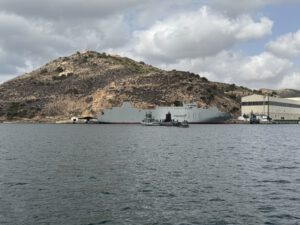
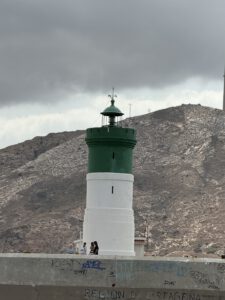
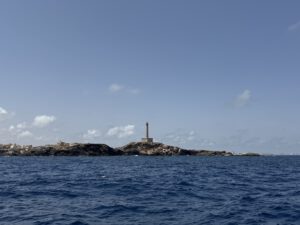
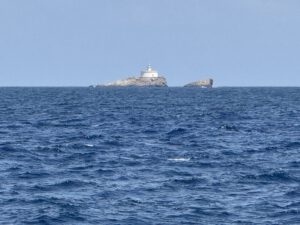
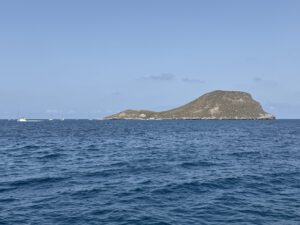
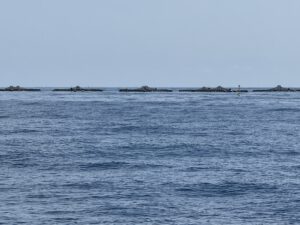
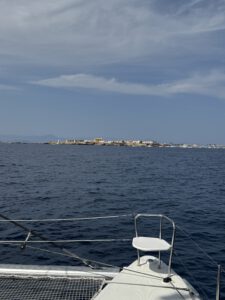
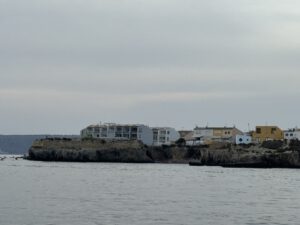
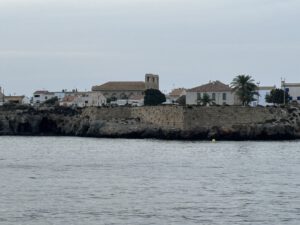
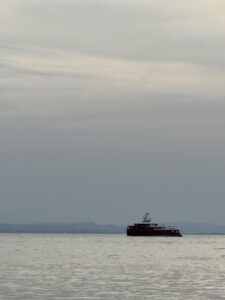
After a quiet night, the morning gets off to a leisurely start as well. We sleep in, have muesli for breakfast, and Axel goes for a swim. Around noon, we weigh anchor and chug off. There’s no wind—at least, none we can use—so we head north under motor power. First, we have to pass by numerous fish farms. I wonder what they’re raising here? Maybe sea bream? The sea is still a bit choppy, so we rock back and forth a little as we cruise along. Since we’re sailing quite far from the coast, there isn’t much to see today—just water and sky, and the occasional other boat. Finally, we reach today’s destination, the small island of Illa de Tabarca. It’s a popular day-trip destination from Alicante and Santa Pola, so the anchorage is quite crowded. Still, we manage to find a good spot for ourselves. Axel jumps right back into the water; for me, the water’s too murky. We watch the hustle and bustle of the other boats and the many tourists on shore and are glad that things quiet down later in the evening as most of the boats set sail back toward their home ports. Aside from us, only a handful of boats stay overnight. Among them is the megayacht Akula, which is anchored far out off the island.
Illa de Tabarca – Cabo de l‘Horta 13,6 nm

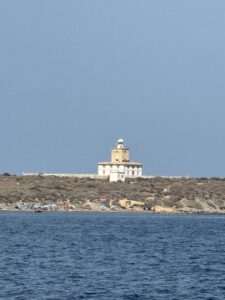
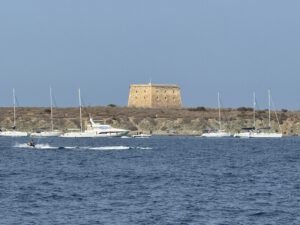
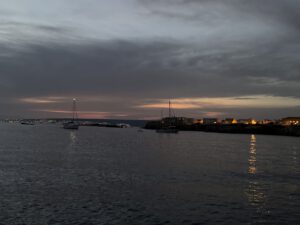
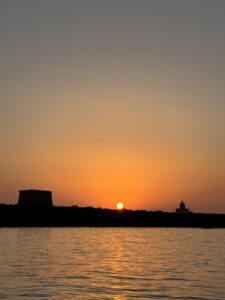
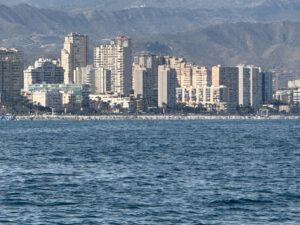
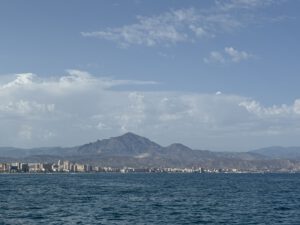
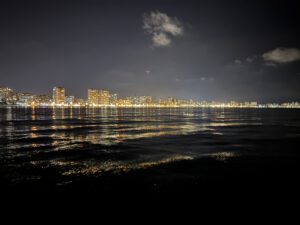
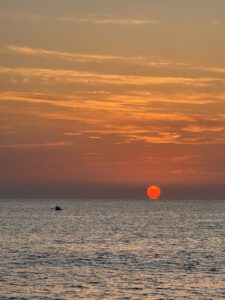
The night is quiet once again, and we’re rocked back and forth ever so gently. I’m awake early again today and can enjoy the sunrise between the fortress and the lighthouse. The sea is as smooth as glass, so today will be another day of motoring. But first, breakfast and a swim in the ocean. We’ll save a visit to the island for our next trip. We’ll probably pass by here twice more, and by then it might be less crowded. Then we’re off. We motor along the west side of the island and then continue north. On our port side, high-rises appear first, followed by the city of Alicante. We’ll save a visit there for next time as well. Strolling through the city at 34° C just isn’t our thing. Instead, we head a little further on to Cabo de l’Horta. We drop anchor off a long sandy beach with a beautiful sandy seabed. As always, we make sure not to anchor in seagrass beds or damage anything. Given the vast sandy areas here, that’s not really difficult, though. The beach is pretty crowded, and here, too, high-rises line up one after another. You can tell that the Costa Blanca, where we’re currently located, is one of the most popular vacation spots. Oh well, we can just look the other way. In any case, the water is beautifully clear again, so we head in for a more or less refreshing swim. After a few minutes of relaxation, we go right back in for another. Oh, it’s wonderful! The water is as warm as our bathtub—30° C—way too warm! The risk of thunderstorms and severe weather is rising every day, and there’s already been heavy rain, hail, and thunderstorms inland. It’s still calm along the coast, but that could change quickly. In any case, we’re keeping a very close eye on the weather around us. Just like in the Caribbean, hurricanes can also form in the Mediterranean. They’re called “medicanes.” This is possible when the water temperature reaches 30°C or higher. In the Caribbean, hurricanes move more or less from east to west in a fairly predictable pattern. They form in the Atlantic and then sweep across the Caribbean. In the Mediterranean, it’s a different story. There, medicanes can form anywhere and move in any direction. On top of that, there are local weather phenomena that can also cause strong winds—sometimes with absolutely no warning, and sometimes with winds of 60–70 knots. But we’ll all have to get used to these weather concerns—not just us aboard La Ola. Even on land, the weather is becoming more extreme and unpredictable. Otherwise, it probably wouldn’t be warmer in Bremen today than it is here on the Costa Blanca. And we wouldn’t be hearing about wildfires in Germany on the radio. What I find troubling is that hardly anyone in Germany is prepared for these weather changes. There’s hardly any air conditioning—neither in private homes nor in hospitals, nursing homes, schools, or daycare centers. It’s more common in office buildings and hotels. The fire departments seem to be poorly equipped—if at all—to handle large-scale fires. Firefighting planes?! I looked it up online: Germany has exactly one permanently stationed civilian firefighting plane named “Hexe 1,” which is deployed in the Harz Mountains during the summer. It’s leased from Poland! And when needed, it’s also deployed in other federal states. By comparison: Portugal has about 80 firefighting aircraft. However, Germany also has numerous Bundeswehr helicopters that can be deployed for firefighting. At least that’s something. I’d rather not think about the preparations and measures for heavy rainfall events. They probably haven’t improved in most regions, even after the disaster in the Ahr Valley in 2021. And no, it’s not always the government’s responsibility to take precautions. Everyone has to look out for themselves a little and take appropriate measures whenever possible. Okay, enough worrying and fretting! We’re taking care of ourselves, and I’m sure you’re doing the same where you are. Quick, back into the water to cool off a bit. Wonderful! Then it’s off to the front cockpit to chill, and just like that, another beautiful day is over.
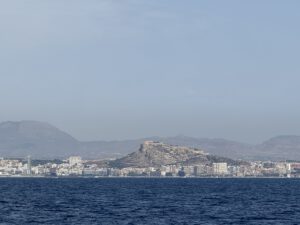
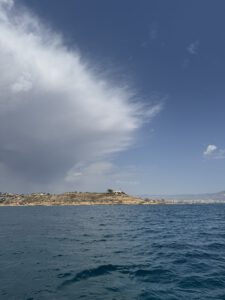
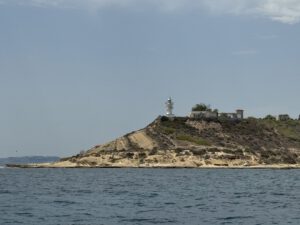
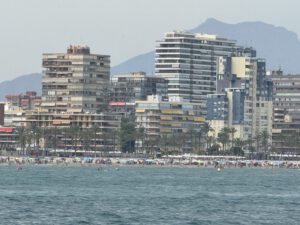
Cabo de l‘Horta – San Juan 2,9 nm
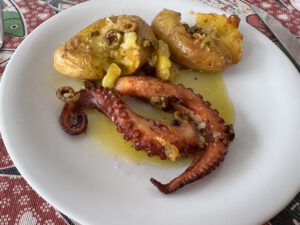
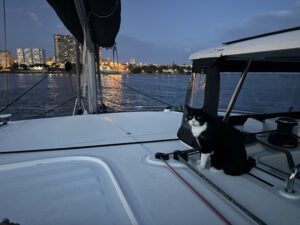
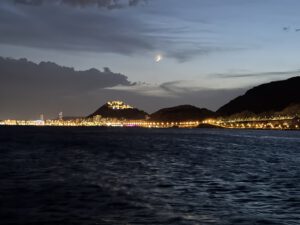
Even though the distance to the next anchorage near Calpe isn’t far, we’re getting out of our bunks early today. The Spanish weather forecast predicts a risk of heavy rain and wind gusts this afternoon, and we don’t want to get caught in that while we’re sailing. So, right at sunrise, we got out of our bunks and had muesli for breakfast. Just to be on the safe side, we check the latest weather report again and promptly change our minds about heading to Calpe. Overnight into Sunday, winds of over 30 knots from the southeast are expected to blow directly into the anchorage there. Not a good idea to anchor there then! So we look to see where else we can make ourselves comfortable. In the end, we decide on San Juan. So, we head back just around the corner. We should be much better protected there, and the forecast doesn’t call for as much wind. Well, of course, we wouldn’t have had to get up so early for the nearly 3 sm journey. Still, we weigh anchor and motor over to the new anchorage. That way, we still have our pick of spots and don’t have to maneuver around the numerous day-trippers. Starting at 11 a.m., the bay fills up noticeably, and we’re suddenly surrounded by small motorboats. I take the opportunity to paddle out in my kayak once again. The bay is full of vacationers on SUPs, kayaks, and just swimming, and I make my way through them. That’s when I spot the Haselcat catamaran. They’re clubmates from the TO, and of course I say a quick hello to the owners, Kemal and Martina. The two of them are headed to the Canary Islands, so unfortunately they’re heading in the opposite direction from us. Too bad—otherwise we definitely would have met up again for a longer chat. Back on board, I first need to relax a bit in the shade. The sun is already beating down hard again, making time in the kayak quite exhausting—even without paddling—despite sunscreen, a UV-protective shirt, and a hat. But how glad I am that we brought our pool along! Now I can just hop in the water and cool off a bit. By noon, the anchorage is so crowded that people on the individual boats can almost reach out and touch each other. Packed tight, everything crammed full. La Ola is guarding its anchor and has simply settled right on top of it. But if the wind picks up and the anchor chain tightens, we’ll end up tangled up with some other boat. Well, they’re all significantly smaller. But they’d still leave scratches on the hull. Let’s hope the threatened thunderstorms—with wind, rain, and hail—stay away and that the whole situation doesn’t turn into total chaos. And we’ll probably have to get used to such cramped conditions, too. The Mediterranean is full, and nice anchorages get crowded quickly. Luckily, the thick clouds roll past us without causing any damage. In the late afternoon, it does actually start to rain briefly, but the heavy drops are gone again in no time. We enjoy some delicious pulpo for dinner once again and then sit out on our rooftop terrace for a while. Lucky joins us too, but eventually it gets too windy and too rocky for all of us. Unfortunately, the swell finds its way into our little cove and sets the few remaining boats dancing. Lambada or flamenco? Hard to say, but La Ola is really shaking her hips. Although, Wilson in front of us—THE Wilson!—is actually swaying even more and is at least twice as fast. We sit a little longer in the calmer cockpit and gaze at the new moon over Alicante. There’s lightning and thunder in the distance, but we seem to be out of the worst of it for now. It would be nice if the night were to pass peacefully!
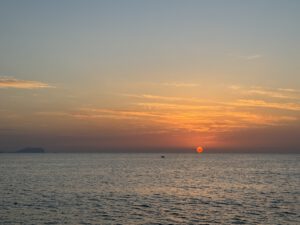
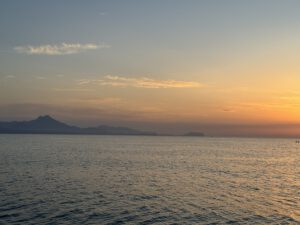
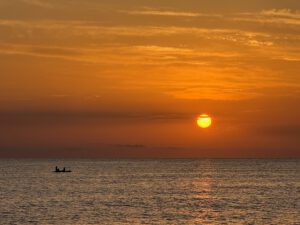
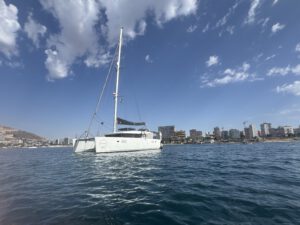
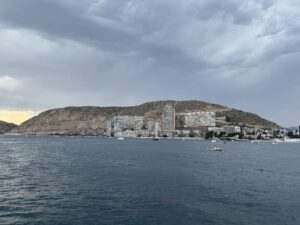
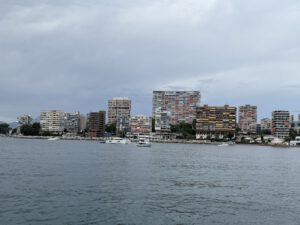
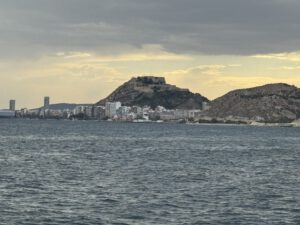
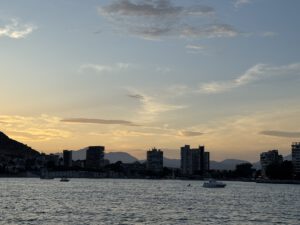
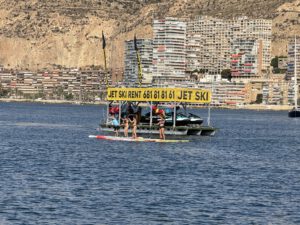
Well, so much for that! Around midnight, a thunderstorm rolls in and it starts raining hard. I have to quickly close the hatches and check to make sure we’re securely at anchor. We are—and luckily, so are our neighbors. Even though it’s lightning, thundering, and pouring, fireworks are going off on shore—not just in San Juan, but also in faraway Alicante. Yesterday was a holiday and the feast day of the patron saint of fishermen. Eventually, the weather calms down again, and I head back to my bunk. The rest of the night remains quiet, and by morning the skies have cleared up again. While we’re having breakfast, the anchorage fills up once more. To our great “delight,” a mobile jet ski rental station sets up right next to us. This is going to be a blast! The various weather reports are once again all over the map today. Sometimes no wind, sometimes strong winds, sometimes headwinds, sometimes blowing right into the anchorage. We’re trying to figure out what to do. Should we head to the marina in Alicante? Or sail a bit further? Drop anchor off Benidorm or head to the marina in Altea? We’ll check with the marinas, because if they don’t have any space anyway or are exorbitantly expensive, those options are out of the question. A short while later, we get replies from the marinas. Altea doesn’t take reservations and says the chances of a spot opening up are very slim. Alicante has space. At first, they quote us a price of 190 euros for two nights. A little later, the price is revised, and we’re told to pay 380 euros. Is it worth it to us? No! We can still check out Alicante from Cartagena. Maybe we’ll even stop by on La Ola. But only if the off-season rates are more reasonable. In the end, we decide to stay at our anchorage for one more day and then move on. That way, we can just laze around on Sunday—reading, swimming, and watching the hustle and bustle in the anchorage. The floating jet ski rental turns out to be hardly a nuisance. A pleasant surprise! The wind and waves are behaving themselves, too, so all is well. In the evening, we grill some burgers, enjoy the sunset on the deck, and then continue reading in the cockpit. Well, until it’s time to turn in. The air conditioning is still on, even though it’s gotten significantly cooler. Only 31°C now, not 36°C anymore.
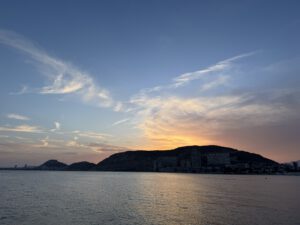
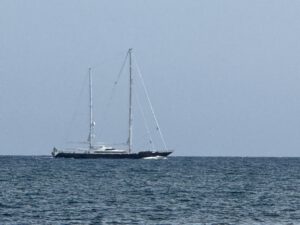
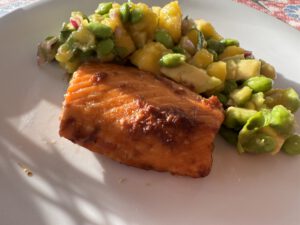
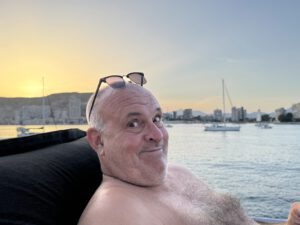
Move on or stay put. The daily balancing act between the urge to travel and the weather forecast. The forecast predicts a 20-knot headwind. Plus, the view out to the open sea—there are quite a few white caps out there. So all signs point to staying put. And why not? We’ve already reached our year-end destination; everything ahead of us is a bonus. If we don’t make it there this year, maybe next year. Of course, it would be great if we could still visit Valencia and Barcelona. Not only are they wonderful cities, but we’d also have a good chance of seeing our friends from Independence 2 (in Valencia), Seren Wen, and Playmobil (both in Ginestra near Barcelona) again. A visit to the Costa Brava would be nice, too. But to get there, we’d have to cover quite a distance. And then we’d have to head back to Cartagena as well. And in the end, the weather has to cooperate. And, even though it’s sometimes very hard for us, it’s worth waiting for the right weather. So we’ll continue to make ourselves comfortable and stay at anchor in San Juan for one more day. Around us, life in the bay is slowly coming back to life. The jet ski rental is being towed in, and small motorboats with their water-loving crews are mooring all around us. Music blares over from the jet skis. Anchored next to us today is a sailing yacht with what feels like 20 guests on board. And no, it’s not 80 feet long—more like 40 feet. So maybe just a touch overcrowded. That doesn’t dampen the fun, though, because as soon as the anchor is down, everyone jumps off the boat. The anchor doesn’t hold, though, so the lively group drifts merrily past us. At least the skipper notices this and decides to let out a little more chain. As we’ve observed over the past few days, Spaniards love to sing. On every boat, people sing along loudly to the music, spreading a cheerful atmosphere. And Spaniards love being in the water. Everyone has a swim noodle or an inflatable flamingo. SUPs and kayaks are also popular. As a result, in the evenings you can hear a distinct hissing sound coming from the boats almost everywhere. It’s a sure sign that a departure is imminent when the air is let out of the water toys. In the late afternoon, new sailing yachts join the anchorage. Foreign flags—Australia, the UK, or the USA. Blue-water sailors who, like us, are making a stopover here before continuing on from A to B or from one adventure to the next. Meanwhile, out in front of the anchorage, the luxury sailing yacht Morning Glory passes us by. Just under 50 meters long, it doesn’t drop anchor with us but instead heads by motor to the marina in Alicante. People in this class probably don’t worry too much about mooring fees. Today, Axel prepares a delicious salmon fillet for us for dinner, served with tomato-mango salsa and edamame beans. Very tasty and soooo healthy! Afterward, we “have” to relax on our roof once again. A gentle breeze blows up there, and you have a view of the sunset. Eventually it gets dark, and we’re a little surprised to see another catamaran anchored next to us. It still has its mainsail up and isn’t taking it down for the night at anchor. Well then…
San Juan – El Oasis/Mar Menor 40,3 nm

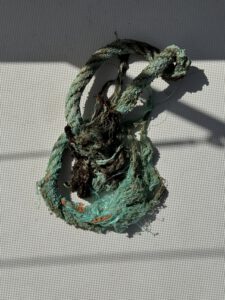
Does this sound familiar? You think, “Finally, we’re moving forward,” and then suddenly things take a turn for the worse? We get up early and are basically ready to go. Until—yes, until—we take a look at the latest weather report. What on earth is coming our way?! The wind fields on the weather map are glowing dark red to black. Gusts over 55 knots?! And right where we’re headed. Ouch! The Spanish weather service has issued a so-called DANA warning. DANA stands for Depresión Aislada en Niveles Altos—an upper-level low-pressure system. Colloquially, it’s also called “Gota Fria,” the cold drop. What does that mean? Very cold upper-level air meets very hot ground and, currently, very warm water. This creates unpredictable weather conditions with the potential for thunderstorms, storms, heavy rain, and hail. Inland, there’s a risk of flooding and landslides. We’re taking this weather situation very seriously and are once again discussing our options. In the end, there are too many reasons against continuing north, as that would put us right in the center of the precarious weather conditions. There would be no anchorages available there, or rather, we wouldn’t have reliable anchorage. We wouldn’t reach the Valencia marina before the storm. The Denia marina, located just before it, has no space available for us. So we’d rather make an orderly retreat. We take advantage of the remaining northeasterly wind and head back to the Mar Menor. There are safe anchorages there for any wind condition, and the wind isn’t expected to get quite as strong further south. No sooner said than done—we weigh anchor. At first we motor, but eventually, once we’re level with Illa de Tabarca, we’re able to set sail. We’re cruising along at 6.5 knots and decide to try our hand at fishing once again. And once again, something “bites”! We manage to remove a shredded plastic rope from the hook and are happy that we’ve once again helped reduce plastic waste in the ocean. We would have preferred fresh fish, though, since our recipe collection offers little inspiration for cooking with plastic rope. Around 4:30 p.m., we reach our chosen anchorage, El Oasis, on the northern outer edge of the Mar Menor. The water here is supposed to be crystal clear, but the visibility is rather murky. Perhaps the northeast wind has stirred up too much sediment? We hope the water quality improves over the next few days and drop anchor in a nicely sheltered spot. Here, too, numerous Spaniards are swimming with their pool noodles around small motorboats. That’s starting to give us a sort of homey feeling. Axel tests the water right away and says it’s quite salty and that visibility is at least 1 to 2 meters. That’s all we used to have in the Baltic Sea, anyway. So everything’s fine. We make ourselves comfortable and grill pork tenderloin with rösti for dinner. We enjoy the whole meal in the shaded front cockpit, and afterward we head up to the rooftop deck. It’s a good thing we have so many spots to choose from! Lucky comes up with us too and takes a stroll across the solar panels. Now, tomorrow we’ll only get electricity from cat paw prints! Of course, we check the latest weather report again in the evening. It’s improved a bit for the Valencia region, but we’ll probably stay here until Friday. Or will we?! Maybe we should head into the Mar Menor instead? However, we learn that the bridge over the small canal leading into the Mar Menor is currently broken. But it’s supposed to be repaired soon. We’ll see how the situation develops. At some point, anyway, we’ll head back down from the roof and into our berths.
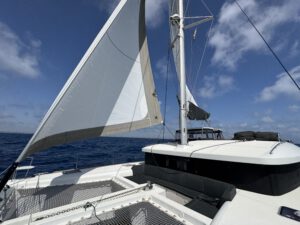
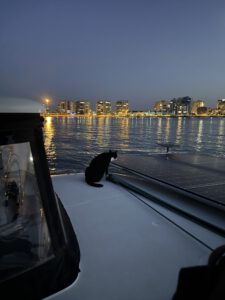
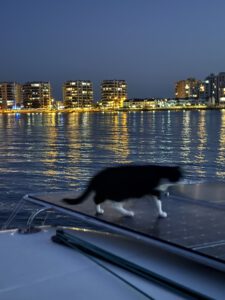
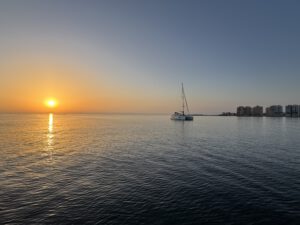
After a wonderfully peaceful night, the morning begins once again with a beautiful sunrise. The sea is as smooth as glass, and from the shore we hear only the occasional bark of a dog—nothing else. Little by little, the first sunseekers appear on the beach, and the anchorage comes to life. We have breakfast in the front cockpit, which faces away from the sun, and then get the dinghy ready. We urgently need to dispose of our trash. After a week of temperatures over 30° C, the bag doesn’t smell too good anymore and is also full. Fortunately, there are easily accessible disposal facilities on shore. And while we’re at it, we head straight to the small Spar supermarket. Since there’s nowhere to moor our dinghy, Axel has to do the shopping this time while I row the dinghy back to the boat. Half an hour later, I pick him up on the beach, loaded to the brim. A shopping shuttle service, so to speak. And a garbage truck. Now that we have fresh bread, vegetables, and yogurt on board again, we can look forward to the next few days with ease. We’re very sheltered at our new anchorage and are glad we didn’t sail to Valencia. The weather forecast there now predicts winds of over 60 knots for Thursday and Friday. Accompanied by thunderstorms and heavy rainfall. It’s supposed to get a bit windier and thunderstormy at the Mar Menor as well, but fortunately it won’t be as bad. For Corsica, there are even forecasts calling for gusts of 94 knots! That would be a Category 2 hurricane or medicane. Let’s hope the forecast is wrong! Or hopefully it’s just exaggerating, and everything turns out to be much less severe than predicted. In any case, we’re not exactly comfortable with these weather conditions. In the afternoon, our friends from the motor yacht Troll come out of the Mar Menor to join us in the anchorage, and we head over to chat with them. Back on board, we hoist our dinghy up into the davits as usual. Unfortunately, the dinghy’s line gets caught in the swim ladder without us noticing. Unfortunately, we notice this too late—only when the pulley we’d just bought in Lagos snaps under the strain and spits out its ball bearings. Darn! We lower the dinghy again, free the swim ladder, and haul the dinghy back up with the broken pulley and a safety line. To make matters worse, the swim ladder is also slightly bent. Double darn!! On top of that, rain clouds are rolling in over land and it’s getting stifling and muggy. Even more stifling and muggy, one might say, since the temperatures right now are certainly not what you’d call cool and pleasant. At some point it starts to drizzle, but somehow most of it seems to evaporate right back up on its way down from the cloud to us. So eventually, with no significant wind or rain, we head off to our bunks. It can stay this way!
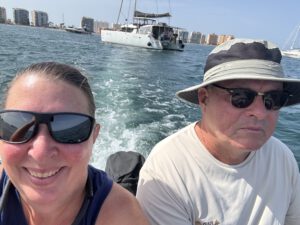
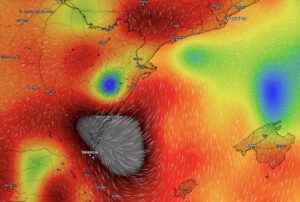
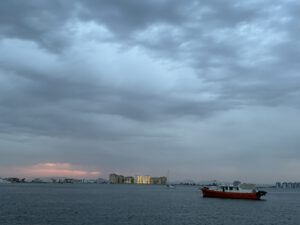
El Oasis/Mar Menor – Playa Paraiso/Mar Menor 10,9 nm

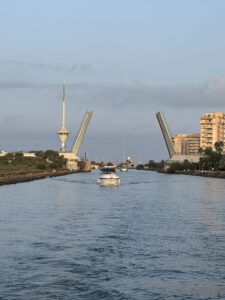
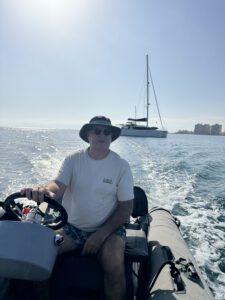
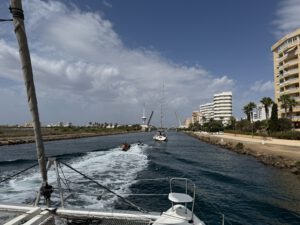
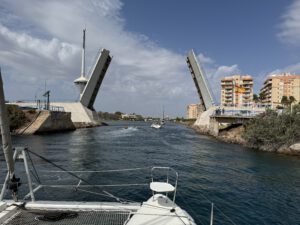
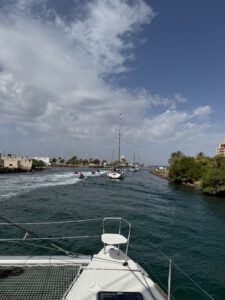
Around half past twelve, the wind picks up and it starts to rain. We’d closed all the hatches beforehand just to be safe, but today the anchor alarm wakes us up. Luckily, it’s just set wrong, and La Ola is firmly anchored in place. After an hour or two, the storm passes, and we’re back to being nice and calm with no wind. At 6:15 a.m., Lucky wakes me up—he’d like his breakfast served “at last.” He gets it, and I go back to bed. While I’m dreaming of hiking through a Chinese7 river delta with Axel, morning breaks, and I don’t wake up until 9 a.m., exhausted from the strenuous hike through the scree. Sometimes I do wonder how I come up with such things in my dreams! But well, it does open up a whole new world. Not real, but still somehow interesting and varied. As I start the coffee maker, a rubber boat from the coast guard heads toward us and kindly informs us that the bridge to the Mar Menor has now been repaired and opens on schedule every two hours. Should we take that as a hint, since we’re being informed personally by the coast guard? We think so, and decide to change our anchorage. So at 11:20 a.m., we weigh anchor and head around the corner to the entrance to the Mar Menor. Already on the way there, the wind picks up. The bridge opens right on time at 12:00 p.m., and we pass through the small channel into the Mar Menor. Only one sailing yacht with tourists is heading out; everyone else wants to enter the sheltered inland sea. By now, the wind is blowing at 25 knots, and a steep, short wave has formed in the shallow water behind the channel. No problem for La Ola, which simply plows through it with ease. Just then, it starts to rain, and the sky grows ominously dark. Over VHF radio, we hear a Mayday call from Cabo de Gata. Five people are in the water there. We hope they’re found quickly, because out at sea right now, in these conditions, it’s life-threatening.* We also hear from Cartagena about a French yacht with engine trouble that apparently is having problems as well. Unfortunately, these won’t be the only emergencies for the time being, and we’re keeping our fingers crossed for everyone at sea that they make it through this lousy weather unscathed! Meanwhile, we sail against the wind to the southern corner of the Mar Menor and drop anchor between Playa Paraiso and Playa Honda. It’s still windy here, but there are almost no waves left. Although we’re in only 3.5 m of water, we’re putting out 50 m of anchor chain. That should be enough to cover all eventualities and ensure the anchor holds even in a hurricane. Our friends from the Troll are anchored next to us; otherwise, the bay is empty. In the afternoon, the clouds clear up a bit, but the strong, gusty wind persists. By now, the wind has been blowing at 35 knots at times. On the bright side, it’s cooling down quite pleasantly—from 36°C to “only” 32°C. It’s almost a little chilly! Unfortunately, our assumption that 50 meters of chain and—as it felt—a well-set anchor would withstand even a hurricane didn’t pan out. Luckily, we didn’t have to test that in the hurricane, but early in the evening, our neighbors on the Troll call us at the same time and the anchor alarm goes off. This time, we’re actually drifting! Even though the wind hasn’t picked up that much. We start the engines, haul up the anchor, and find a thick clump of seaweed wrapped around it. It would be enough for a salad in a pretty big bowl. It obviously couldn’t hold us like that. We give it another try and hope to find better holding ground this time. It certainly feels like the anchor is biting into the seabed properly again, and we let out plenty of chain once more. Fortunately, the weather forecast also predicts that the wind will die down significantly by evening. And the thunderstorm that had been predicted earlier has also disappeared from the forecast. So, time to calm our nerves again and fine-tune the anchor alarm a bit. After all the excitement, it’s time for dinner. Mediterranean vegetables with goat cheese from the air fryer. Quick, delicious, healthy. The wind dies down significantly, just as predicted, and hopefully we won’t have to worry about the night anymore. Strong winds during the day—if you have to deal with them at all—are much better than at night. Looking at the weather map, we’re right between two rain or thunderstorm fronts passing south and north of us. Even though the anchorage is modest, the weather is still the best you can get in the Mediterranean right now.
The five people were actually rescued unharmed!
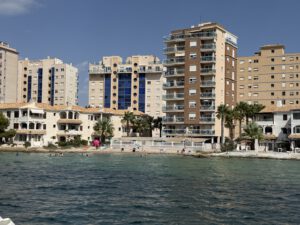
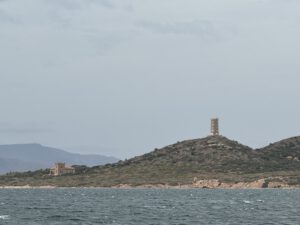
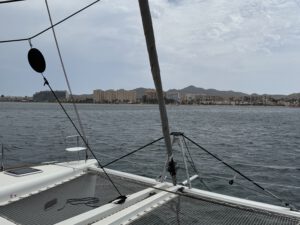
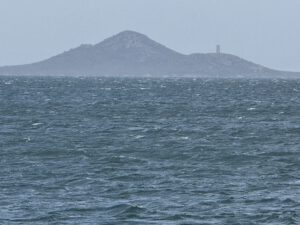
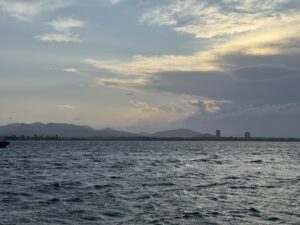
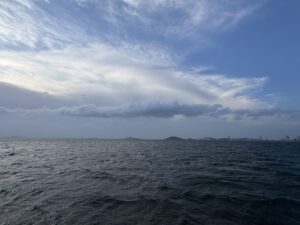
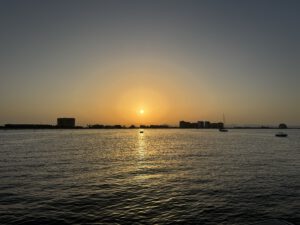
Fortunately, we’re spared any more wind or rough seas during the night. However, an inexplicable wave creeps in from the northeast, running perpendicular to La Ola. As a result, the boat rocks and the water splashes against the hull. I get up a few times during the night to check on things. But aside from a surprised and very delighted Lucky, I find nothing that should prevent me from getting back to sleep. In the morning, not a single cloud is visible in the sky, and the Mar Menor lies as smooth as a mirror—like a silk scarf—between the surrounding mountains and dunes. It finally cooled off nicely overnight, down to just 25°C, but now the sun is beating down with full force again. After breakfast, we start by repairing our dinghy mount, swapping out the new, broken pulley for the old, undamaged one. Then we launch the dinghy, and I head ashore. Axel is once again in charge of taking out the trash and doing some shopping, while I row the dinghy back to La Ola. Unfortunately, here, too, you can’t and aren’t allowed to just leave your dinghy on the beach. While I do the dishes, Axel first runs to the pharmacy (for ear drops to treat an ear infection) and then to the local Spar supermarket. After half an hour, I pick him up at the beach and we head back on board. In the afternoon, Hildebrand from the Troll stops by and we chat for a while. Then he takes our kayak for a test run and brings it back in the evening, quite impressed. Test passed. We prepare a delicious gyros-style chicken stir-fry with tzatziki for dinner and enjoy the sunset and a beautiful evening atmosphere at our anchorage. Pleasant live music drifts over to us from shore, and the air has cooled down nicely in the evening. May it stay this way!
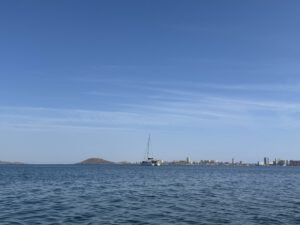
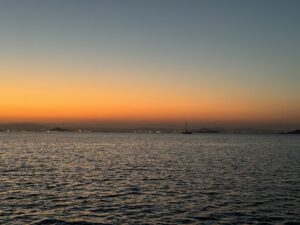
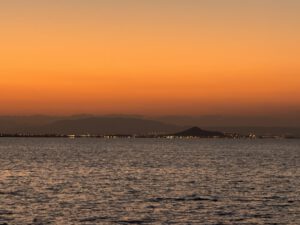
Playa Paraiso/Mar Menor – Punta Seca/Mar Menor 6,2 nm

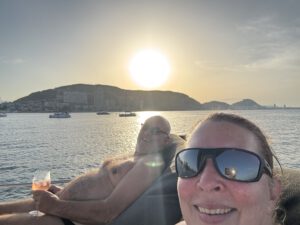
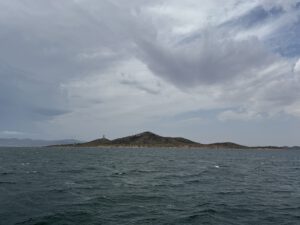
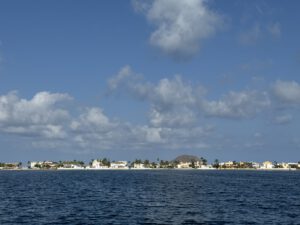
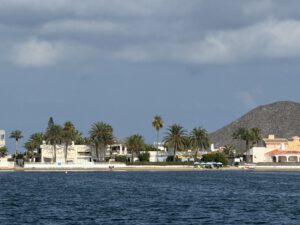
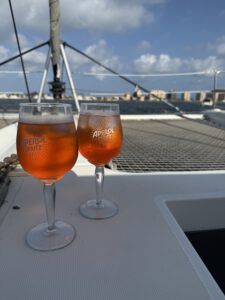
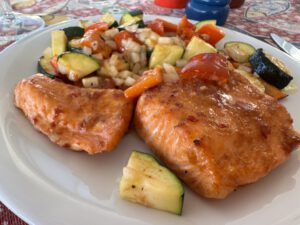
After a quiet night, Saturday morning starts early at 6:45 a.m. with a half-starved cat. Or so Lucky claims, very loudly, anyway! I manage to save him just in the nick of time, and since I’m already awake, I head straight to the cockpit with a cup of coffee. After weathering the last DANA storm system well, the weather is expected to remain unstable. So we’re once again going back and forth about where we want to take La Ola over the next few days and weeks. The Mar Menor certainly offers good shelter from any wind direction, but the anchorage is so overgrown with weeds that we don’t really trust it anymore after our anchor slipped. Besides, there are hardly any opportunities to take the dinghy ashore and leave it there for a few hours. As a result, trips ashore are nearly impossible. And even though we enjoy being on board and at anchor, we do miss the variety that shore excursions offer. Not to mention that, aside from high-rise apartment complexes and beaches, there aren’t really many sights to see in the Mar Menor. So the Mar Menor is out of the question as a mooring spot for the next few days. Safe and sheltered anchorages outside the Mar Menor are unfortunately few and far between. Especially with the changeable winds forecast for the next few days, we’re having a hard time deciding which direction to head in. Neither north nor south or southwest is suitable for a longer stay. A trip to the Balearic Islands would offer us a wider range of anchorages, but we don’t trust the weather enough to take that risk. We consider September to be the month when the Balearic Islands are far too prone to thunderstorms, heavy rain, and tornadoes. This is exacerbated by the currently very high water temperatures. A precarious general weather situation that we don’t want to expose ourselves to. So what’s left?! In the end, we decide to simply move into our booked winter storage in Cartagena earlier than planned. The marina has space for us, and there we’ll be prepared for any bad weather. And the next bout of strong winds is actually already forecast to arrive again starting Monday. With thunderstorms at night. So let’s get out of here. After a late breakfast and a light lunch, we weigh anchor in the afternoon and move closer to the exit from the Mar Menor. This way, we can time the bridge passage better and also get to see another part of the Mar Menor. The distance isn’t far, and after 1 1/4 hours, we drop anchor off Punta Seco. The view is amazing! Punta Seco is one of the few places on the Mar Menor where there are no high-rises. In the background, Isla Grosa looms on the horizon, and in the foreground are chic villas with palm trees, a sandy beach, and beach umbrellas. You just have to tune out the high-rises to the left and right. We treat ourselves to an Aperol Spritz as a sundowner (perfect for meditative singing bowl therapy—I saw that recently at Claudia’s at the Morning Sun) and are happy that we’ve found another beautiful spot. Axel is preparing salmon with Asian vegetables for dinner, and we’re already looking forward a little to returning to Cartagena. We’ve already started planning our “winter season.” We’re set to visit Axel’s parents in Germany for their 65th wedding anniversary. And we’re considering a round-trip tour of Morocco. And of course, Cartagena and the surrounding area also have plenty of new things to offer. Axel has also launched an exciting 3D printing project with Hildebrand from Troll, which should keep him busy for the next few months. So we won’t be bored, even if we’re “settling down” a bit earlier than planned again. And yes, we have to plan for the 2027 season, too—even if our plans never work out exactly as we originally envisioned. Exploring new destinations and regions is fun in itself, even if you never actually reach those destinations. You still learn a lot of new things and get to know new cultures—even just on paper.
Punta Seca/Mar Menor – Cartagena 27,7 nm
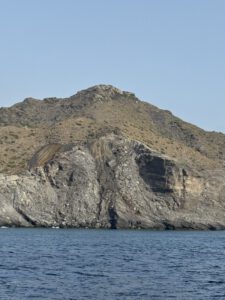
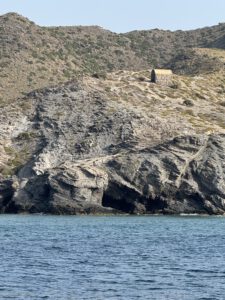
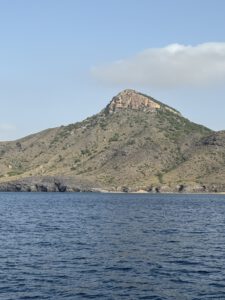
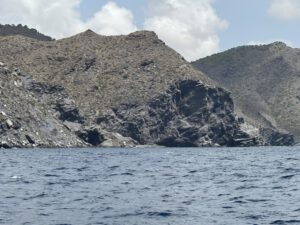
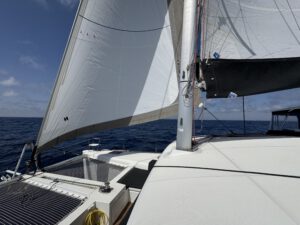
The cat alarm clock is only working halfway again. It wakes me up, but unfortunately too early. Oh well, better than too late. Set Cat Alarm 1 for 5:30 a.m. and silenced it using the snooze function—along with a reminder that the bowl is still full of dry food. Cat Alarm 2 at 6:30 a.m.—snooze function no longer available—so I got up and served him breakfast. Back to bed, and a quarter of an hour later, finally chased out of bed by the “real” alarm clock—and on a Sunday, no less! Nothing to be done about it; we want to catch the first bridge opening to leave the Mar Menor again. So, out of bed, anchor up, and off we go. Right on time at 8 a.m., we pass under the open bascule bridge and head out onto the Mar Mayor, the Mediterranean Sea. We’re the only ones heading out; a sailing yacht is heading in. After the bridge, we turn the bow south, pass Cabo de Palo, and veer west. The wind is light and the current is against us. Eventually, we hoist the genoa for extra speed, and at some point the current shifts and propels us forward faster. We sail along another stunning coastline with towering mountains. At one point, my breath catches a little, because at a dizzying height I can see hikers in red jackets walking along a cliff face that drops almost vertically into the sea. More hikers in yellow jackets are coming toward them. And it’s not even 10 a.m. yet! Eventually the wind dies down, and we roll up the genoa again. Around 1 p.m., we reach the port of Cartagena and are assigned a berth further inland in the marina this time. It looks like this will be our berth for the winter. Marinero José helps us tie up, and our first solo Mediterranean mooring maneuver goes reasonably well and without mistakes—though we still need to work on the finer points. After we’ve tied up, Axel first has to rinse the deck with fresh water. The guide lines from the mooring lines—not called “slime lines” for nothing—have made everything dirty. Meanwhile, I start the first load of laundry in our washing machine. After two weeks without a shore connection and in water-saving mode, this is desperately needed. Then we head to the marina office, where we check in for the next few months. We book our berth until the end of March. Even if we end up heading out to sea again, this way we’ll always have a safe berth to fall back on. No worries about the weather as long as we stay nearby. At 5 p.m., we head one dock over to visit our friends Julia and Paul from Spisea, who’ve been staying in Cartagena for the past two weeks. It’s Julia’s birthday today, and we bring over a bottle of rosé sparkling wine. We drink it together. As is customary among sailors, we swap stories and discuss plans. Eventually, we head back on board, where we make ourselves a delicious Hawaiian toast for dinner. We plan the next few days and brainstorm boat projects for the winter. It’s amazing, but there’s still room for improvement aboard La Ola. Fortunately—and knock on wood three times—there’s nothing that needs repairing. All the systems on board are working perfectly. That’s good, because then we’ll have more time to explore the city of Cartagena and go sightseeing in the surrounding area. And maybe even head out for another week or two of sailing. “Weather permitting,” as we sailors like to say. So things are sure to stay exciting over the next few months!